Nepedia

Danish pastry

Yeast pastry layered with butter, folded around a soft apple-and-sultana centre and brushed with apricot glaze. Start the dough the day before and keep it cool while rolling.

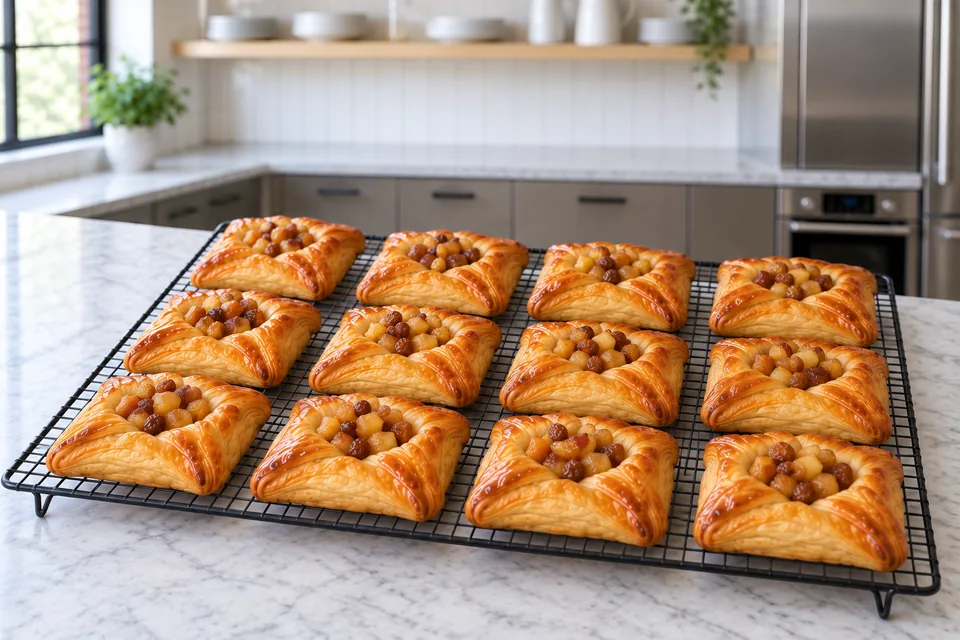
Twelve golden folded-corner Danish pastries with apple-and-sultana centres.
Makes
12 pastries
Heat
200°C conventional
Baking time
18–22 min per tray;36–44 min for two trays
Cuisine / style
Denmark

Keep the second proofed tray chilled while the first bakes.

View

Apple and sultana Danish pastries

Makes
12 pastries
Heat
200°C conventional
Baking time
18–22 min per tray;36–44 min for two trays
Cuisine / style
Denmark

Keep the second proofed tray chilled while the first bakes.

Denmark · Danish pastry

Apple and sultana Danish pastries

Yeast pastry layered with butter, folded around a soft apple-and-sultana centre and brushed with apricot glaze. Start the dough the day before and keep it cool while rolling.

Method

  1. 01 · Mix the dough and chill

    65–70 min

    Use: Plain flour; Granulated sugar; Fine salt; Instant dried yeast; Unsalted butter for the dough; Whole milk; Water; Beaten whole egg

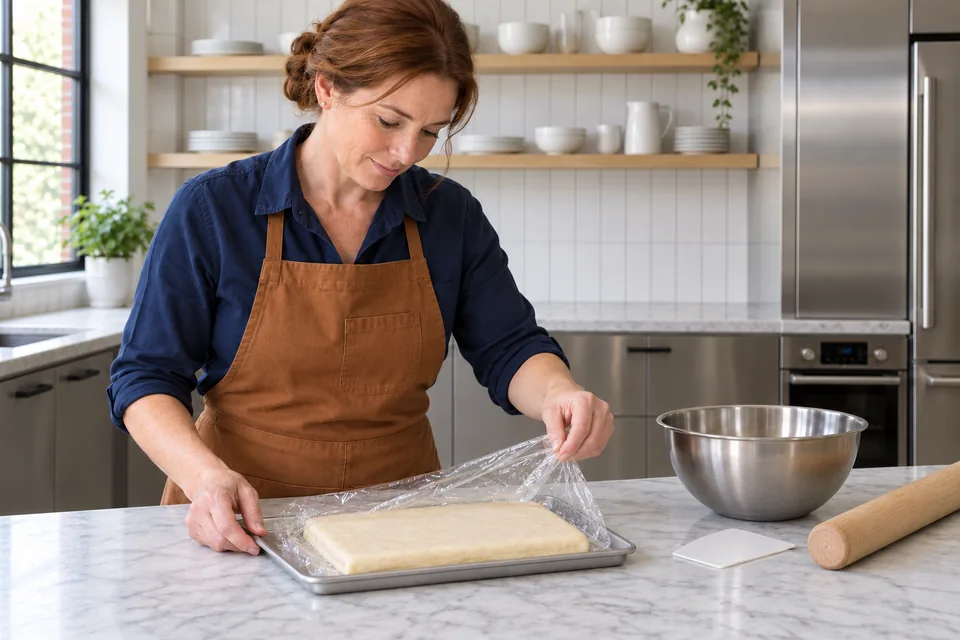
    Mix the dough flour, sugar, salt and yeast. Rub in the 14 g dough butter, then add the cold milk, water and dough egg. Mix and knead gently for 3–5 minutes, until cohesive but still slightly tacky. Flatten into a thick rectangle, wrap and refrigerate for 1 hour.

    Ready when: No dry flour remains; the chilled dough is cool and firm without being frozen.
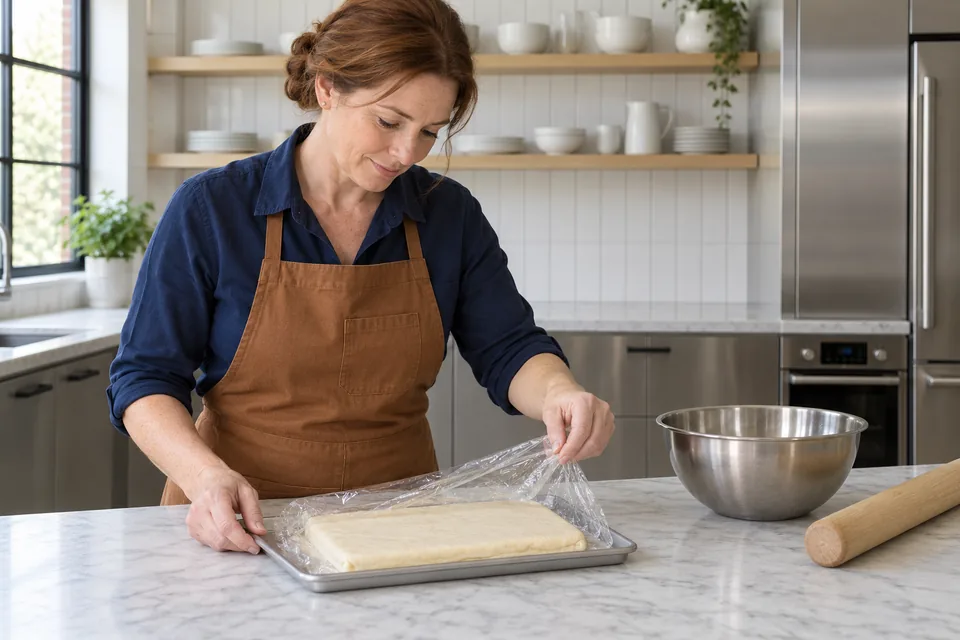
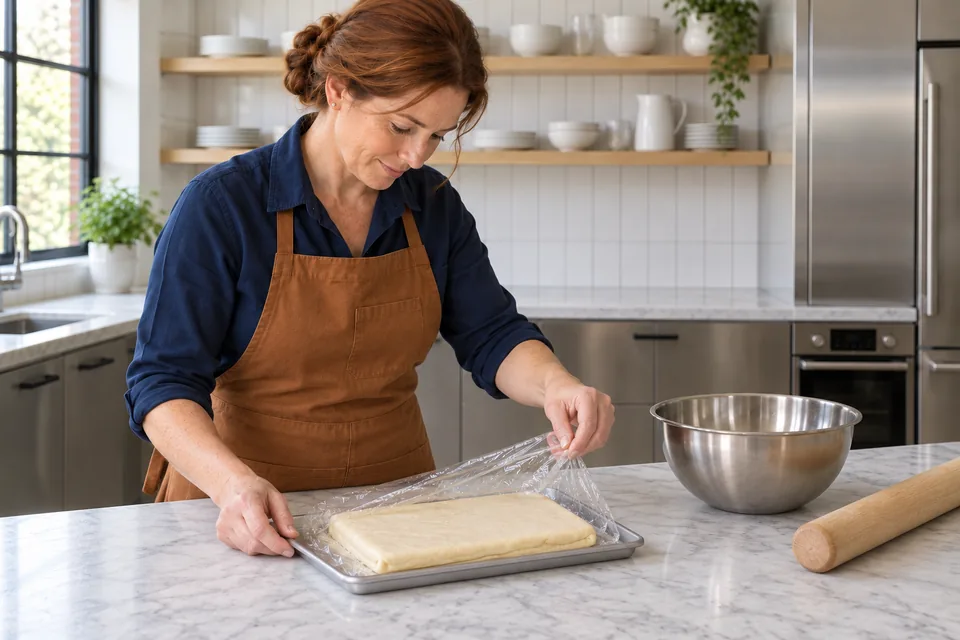
    Cook unwrapping a chilled rectangle of enriched Danish dough.
    01 Mix and chill the doughMix a cohesive dough, wrap and chill until cool and firm.
  2. 02 · Enclose the layering butter

    10–15 min

    Use: Unsalted butter for layering; Flour for rolling

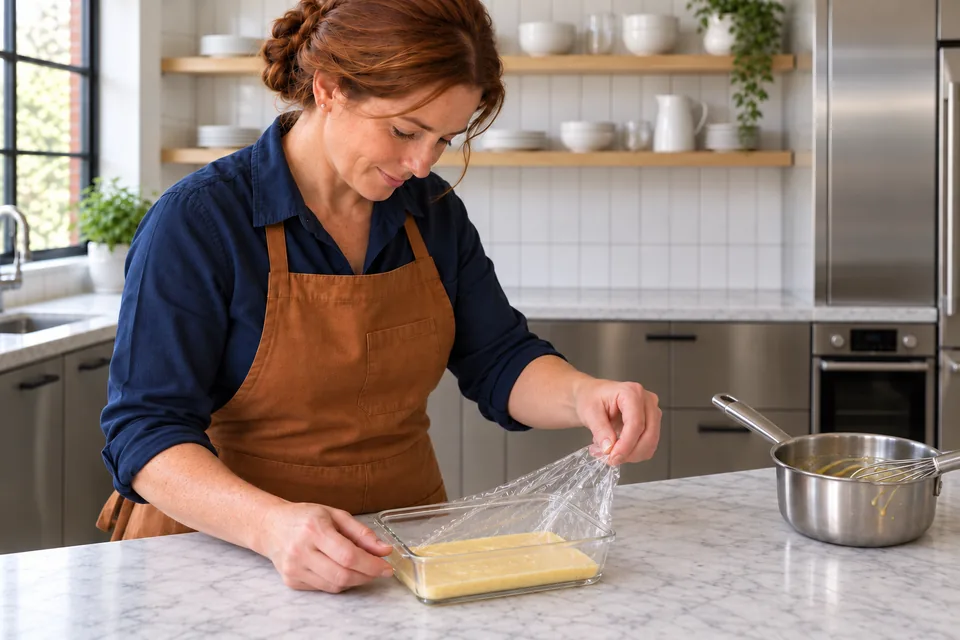
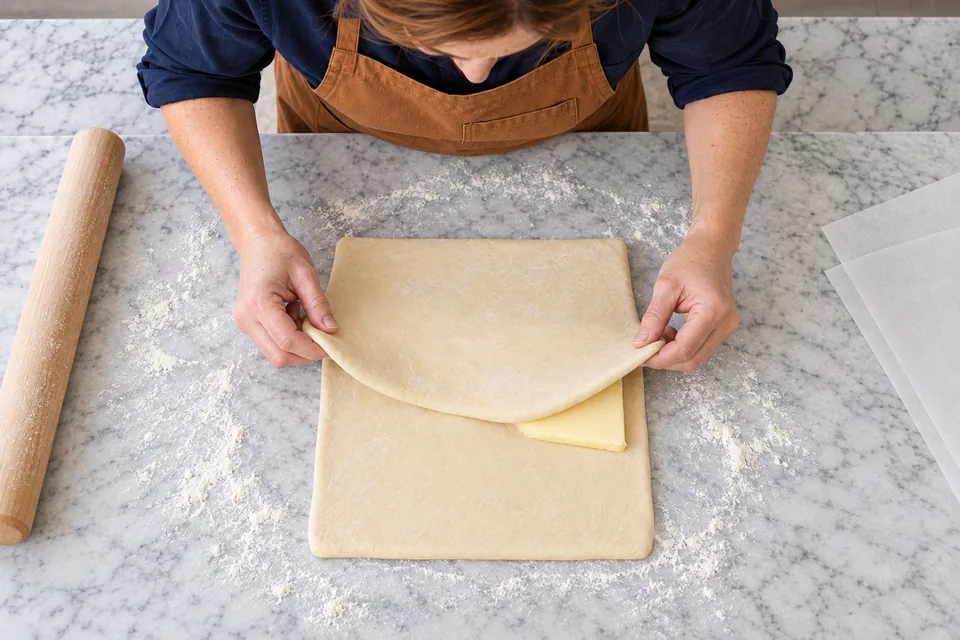
    Between two sheets of baking paper, pound the 213 g layering butter into a 15 cm square. It should bend under pressure without cracking or becoming greasy. Lightly flour the worktop and roll the dough to 16×32 cm. Put the butter on one half, leaving a narrow border; fold the empty half over and pinch the edges shut.

    Ready when: One complete butter block is sealed inside the dough, with no exposed butter. Dough and butter feel similarly pliable.
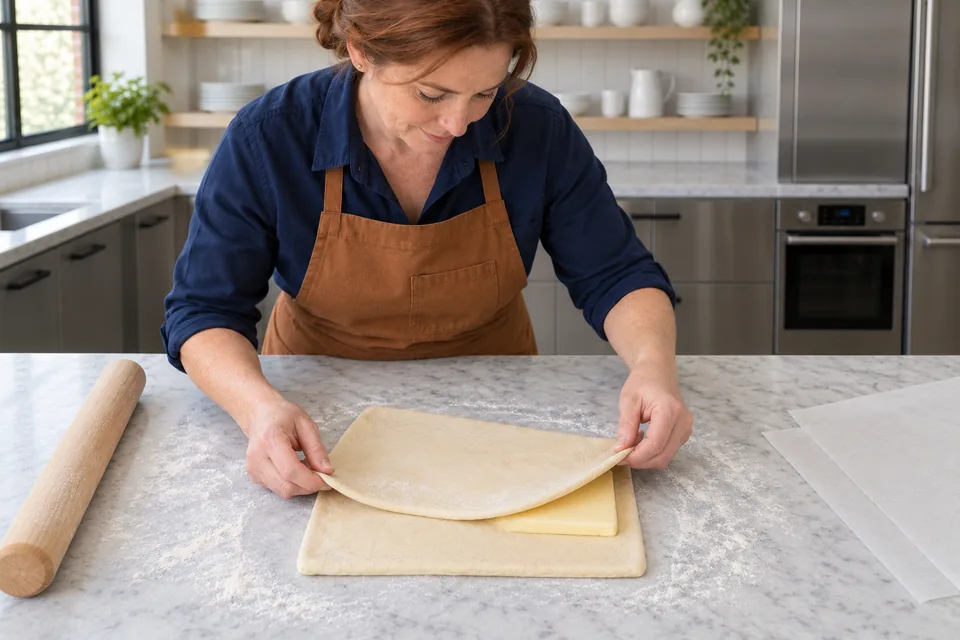
    Hands folding the empty half of the dough over one butter square.
    02 Enclose the butter onceEnclose the single pliable butter block and seal the dough edges.
  3. 03 · Make three letter turns and chill overnight

    560–805 min

    Use: Flour for rolling

    Roll the packet gently to 20×45 cm. Brush off loose flour. Fold one short end over the middle third, then the other end over it, like a letter. Wrap and chill for 30 minutes. Turn the packet 90 degrees and repeat this rolling, folding and 30 minute chill once. Turn it again and make a third letter fold in the same way. Wrap securely and refrigerate for 8–12 hours. Chill earlier if butter starts to soften or escape.

    Ready when: After three letter folds the packet is neat and cool, with the butter still enclosed. No extra butter is added during the turns.
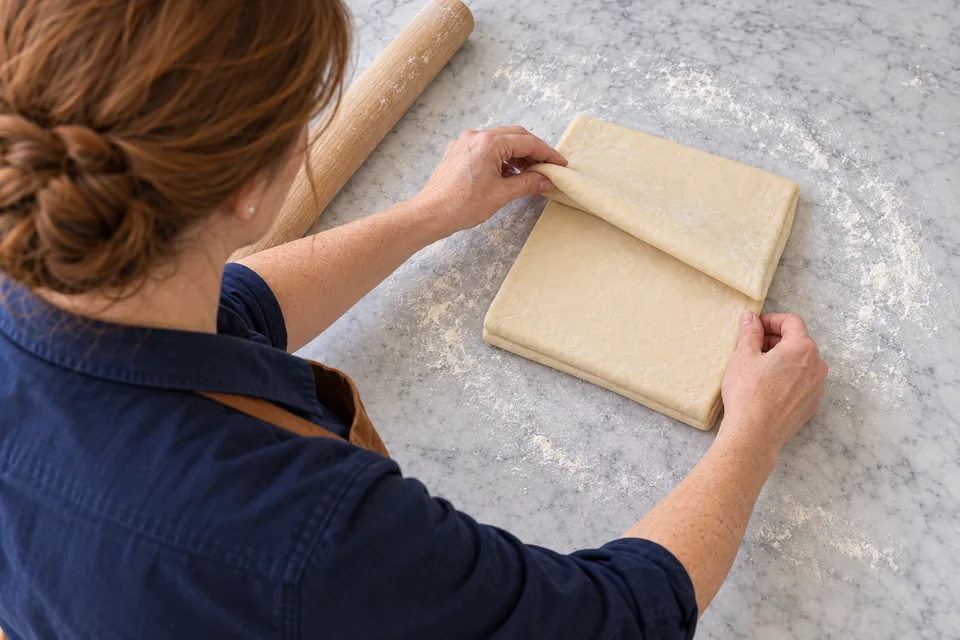
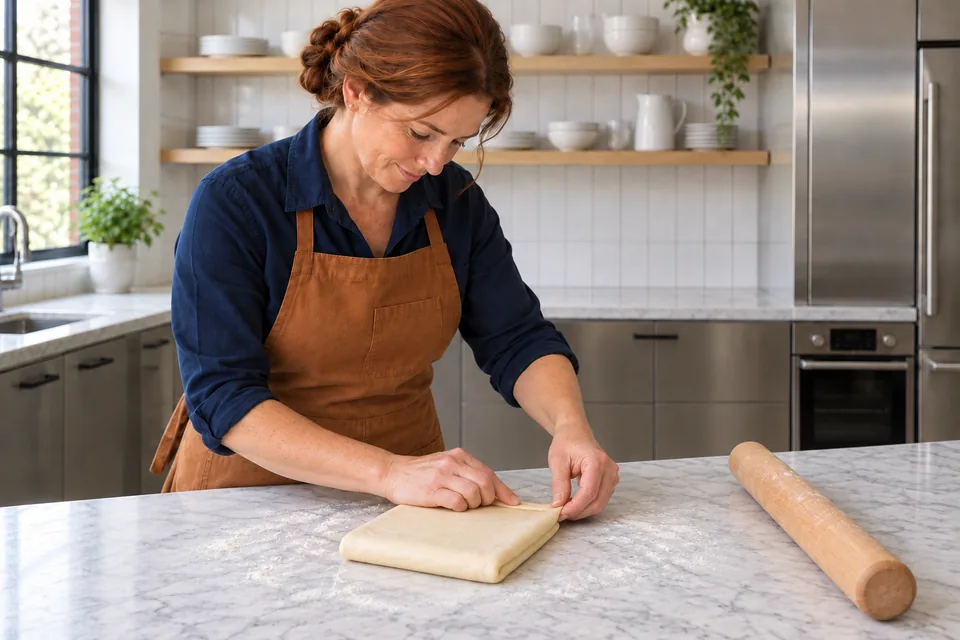
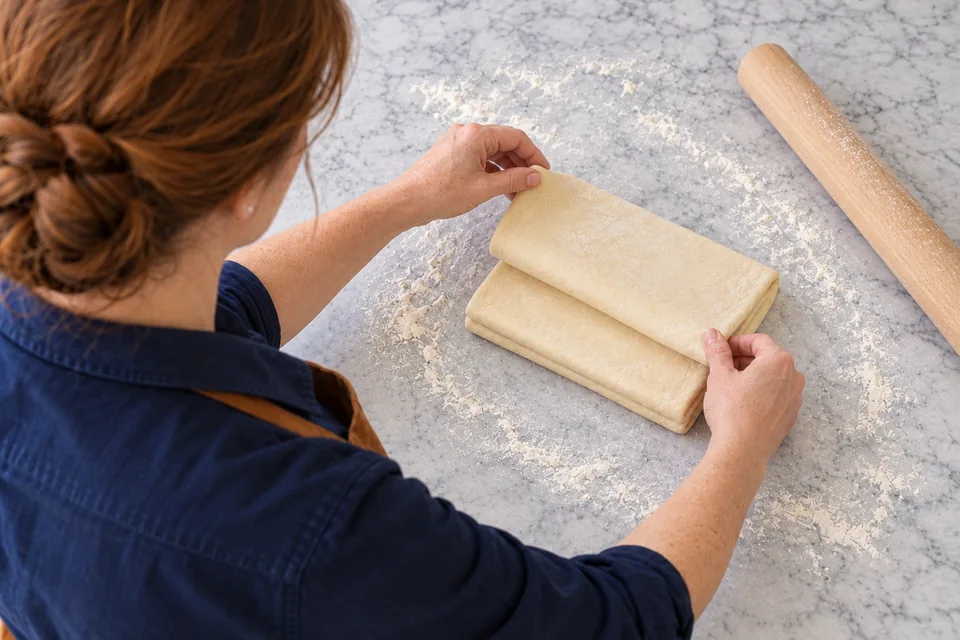
    Hands completing a letter fold in one cool laminated dough sheet.
    03 Make the letter turnsGive three letter turns with chilling, then rest overnight.
  4. 04 · Cook and chill the apple filling

    15–45 min

    Use: Prepared apple; Sugar for the filling; Ground cinnamon; Water for cooking the apples; Sultanas

    While the dough chills, cook the apple, filling sugar, cinnamon and filling water in a small saucepan over gentle heat for 8–12 minutes, stirring until the pieces soften and loose liquid evaporates. Stir in the sultanas. Spread in a shallow container, cool promptly, then cover and refrigerate until needed.

    Ready when: The filling is soft but holds a spoonful without a puddle of juice. It must be cold before touching the pastry.
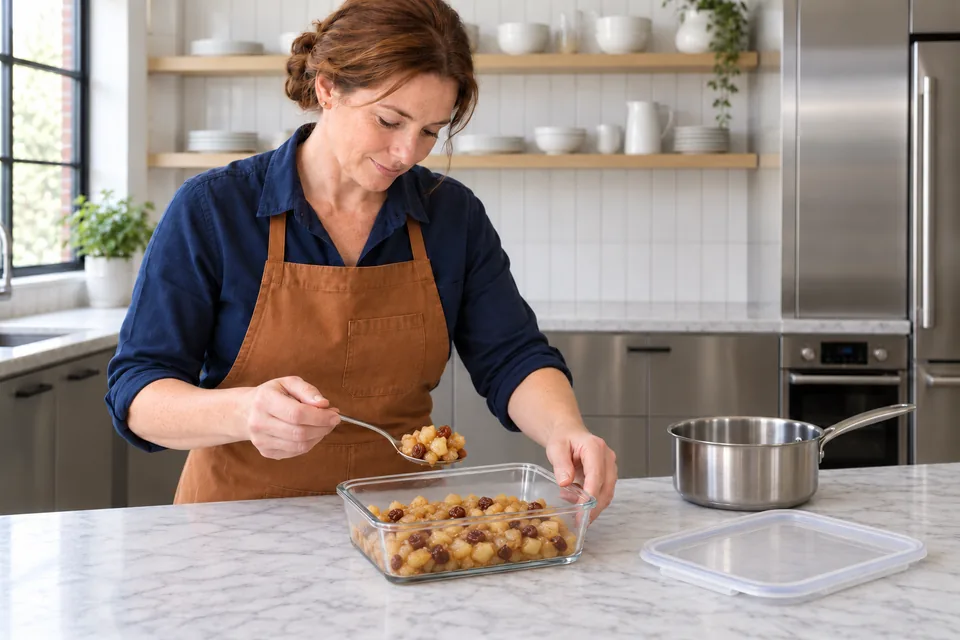
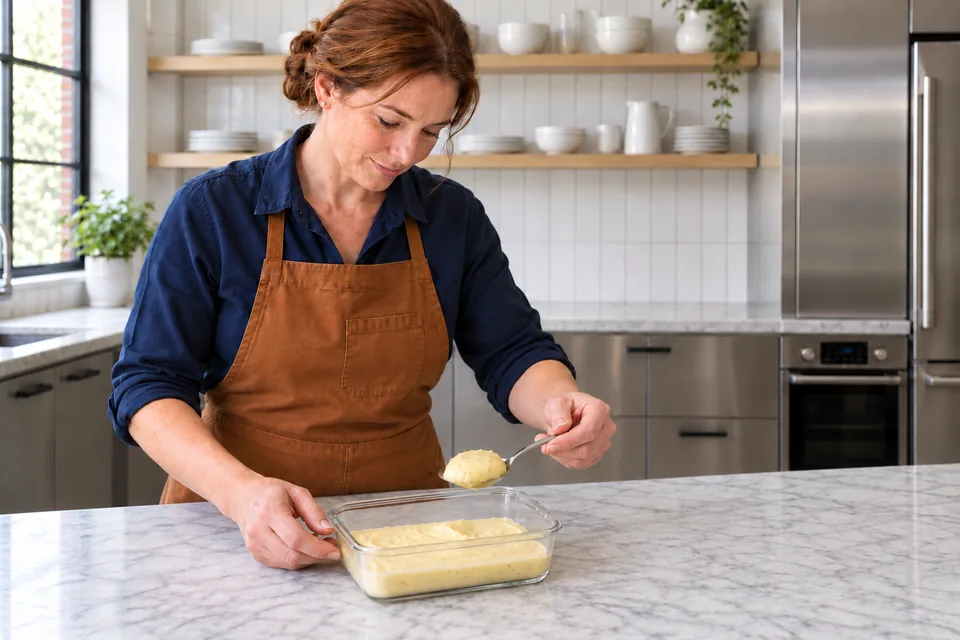
    A compact spoonful of cooled apple-and-sultana filling above its shallow container.
    04 Cook and chill the fillingCook away loose liquid, add sultanas and chill the filling.
  5. 05 · Cut twelve squares and fill

    15–20 min

    Use: Flour for rolling; Prepared apple; Sultanas

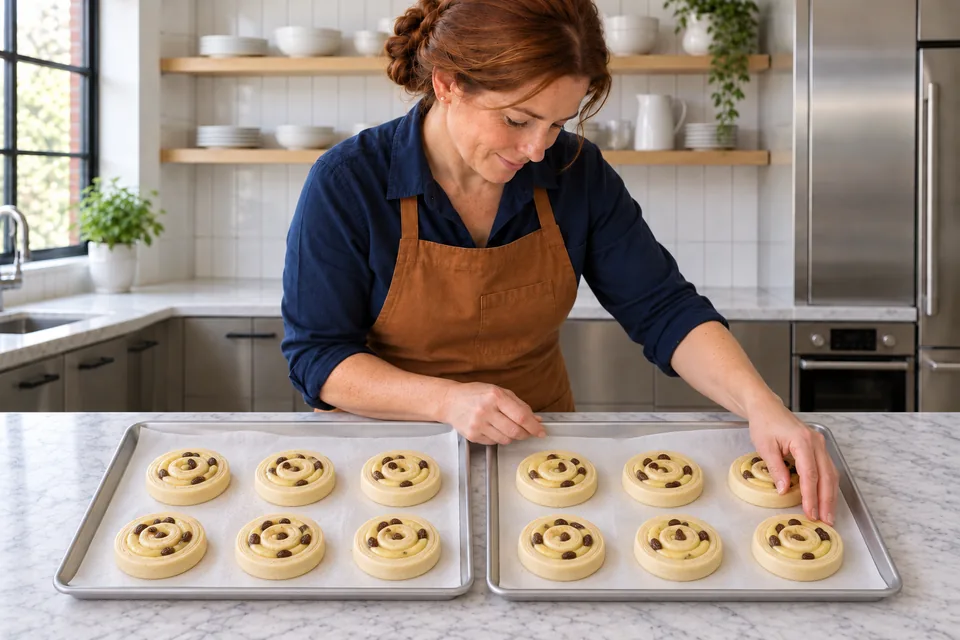
    Line two 30×40 cm trays. On a lightly floured surface, roll the dough to 30×40 cm, about 6 mm thick. Trim only ragged edges if needed, then cut a three-by-four grid of 10 cm squares. Fold each corner toward the centre and press the overlapping tips together. Place six pastries on each tray. Divide 300 g of the cold filling between the centres, 25 g each; keep any extra filling separately.

    Ready when: There are twelve pastries with clear folded corners and compact centres. Filling does not run onto the cut edges.
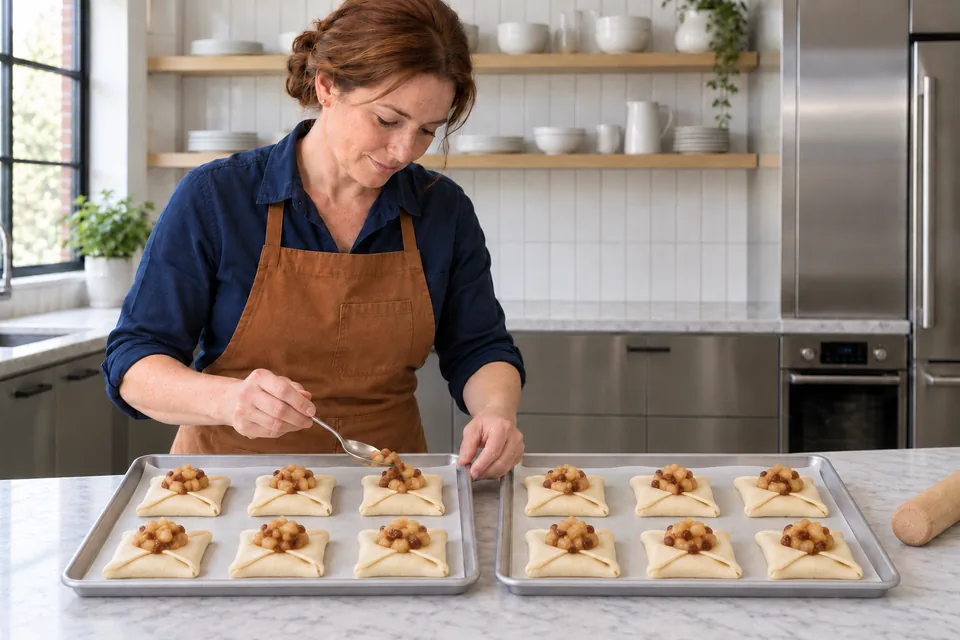
    Twelve folded raw Danish pastries with apple-and-sultana centres on two trays.
    05 Fold and fill twelve squaresFold the corners and add 25 g of cold filling to each centre.
  6. 06 · Proof gently and heat the oven

    60–90 min

    Use:

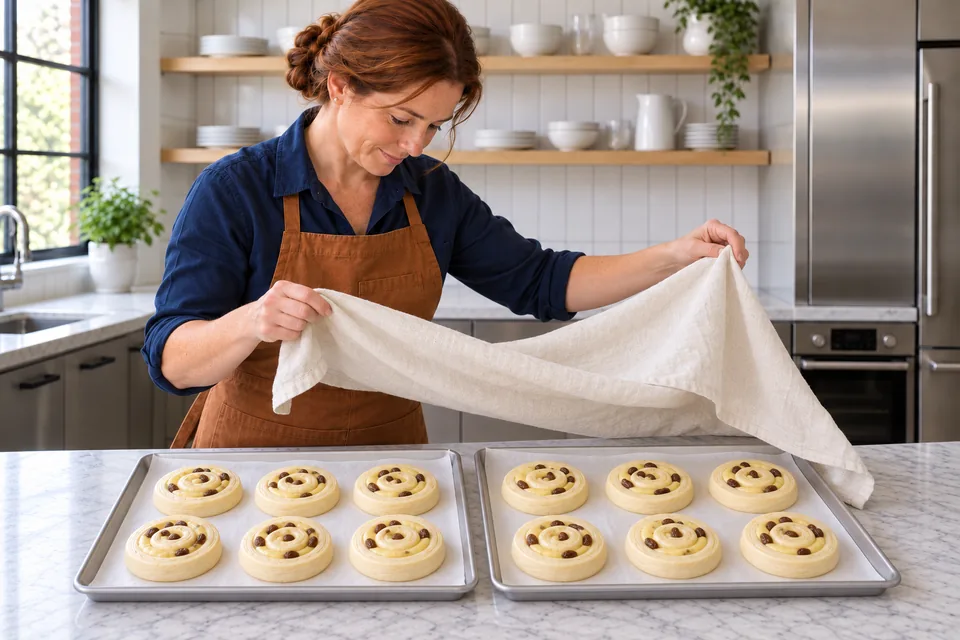
    Cover loosely and leave at 20–24°C for 60–90 minutes. Keep them away from direct heat so the butter stays inside the layers. Heat the oven to 200°C conventional during the final 20 minutes. When both trays are puffy, refrigerate the second tray while the first bakes.

    Ready when: The pastries are visibly fuller and light-looking, with distinct layered edges and no pool of melted butter.
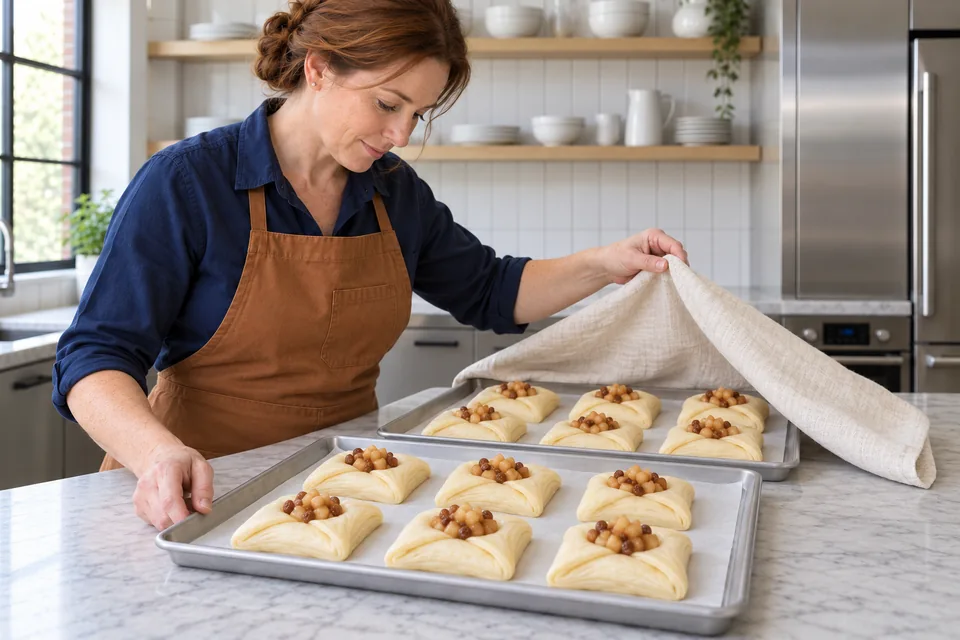
    Cook uncovering twelve puffy filled Danish pastries.
    06 Proof without melting the butterProof gently until fuller, with the butter kept inside the layers.
  7. 07 · Brush and bake one tray at a time

    38–47 min

    Use: Beaten egg for brushing; Water for the egg wash

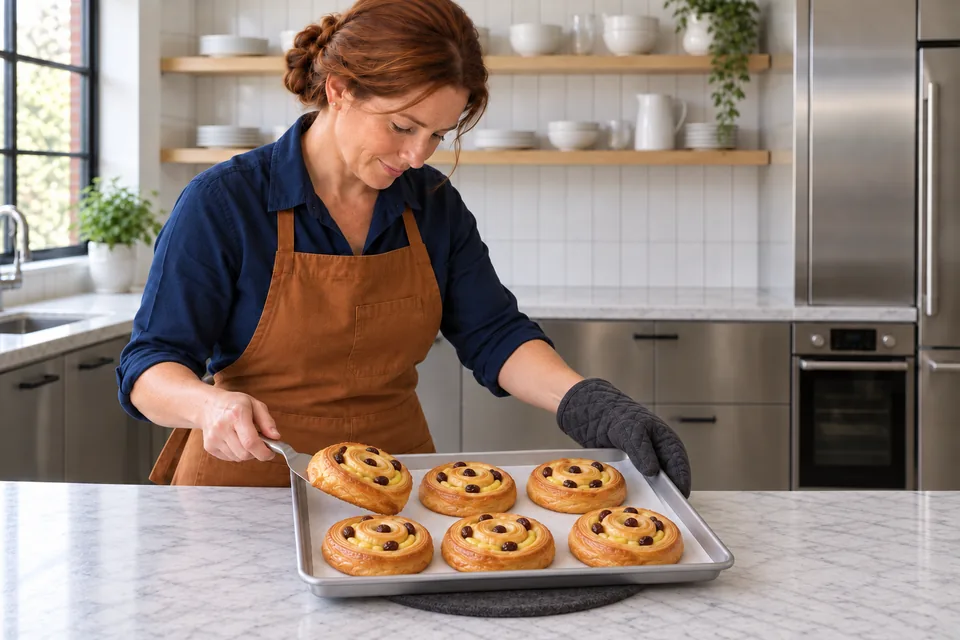
    Mix the separate wash egg and water. Brush exposed dough lightly, avoiding the cut layered edges. Bake the first tray for 18–22 minutes, then bake the second for the same range. Lift a pastry carefully to check its base.

    Ready when: The pastry is golden on top and underneath, with set layers around the filling rather than a wet dough band.
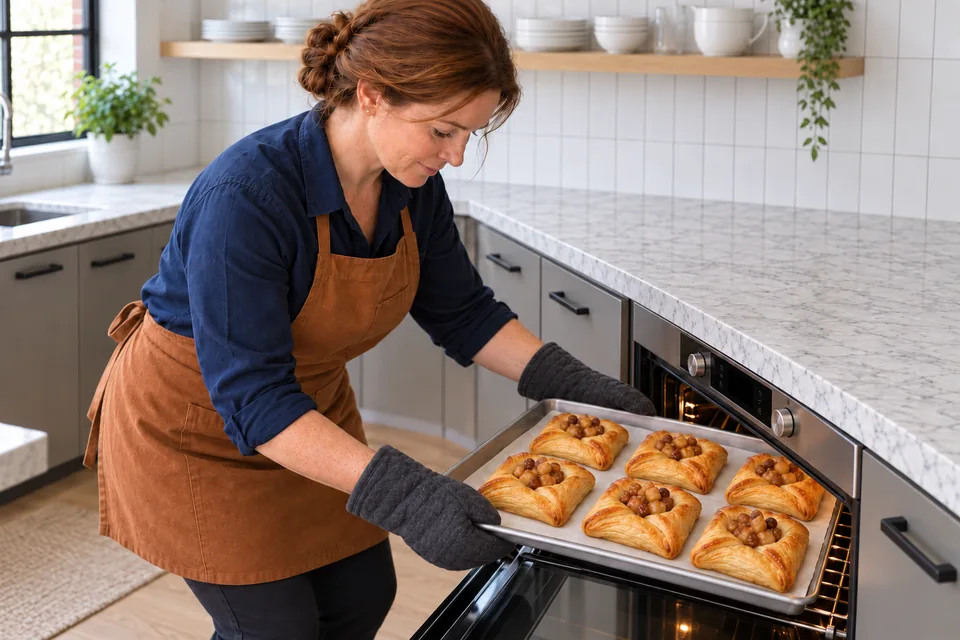
    Cook using oven gloves to support a tray of six baked apple Danish pastries.
    07 Bake one tray at a timeBrush exposed dough and bake one tray at a time until golden underneath.
  8. 08 · Glaze and cool

    30–35 min

    Use: Smooth apricot jam; Water for the glaze

    Warm the apricot jam with its glaze water until smooth. Brush a thin layer over each warm pastry and move it onto a rack. Cool for at least 30 minutes before serving.

    Ready when: The glaze makes a light sheen and the pastry centre is set; the apple filling is warm rather than scalding.
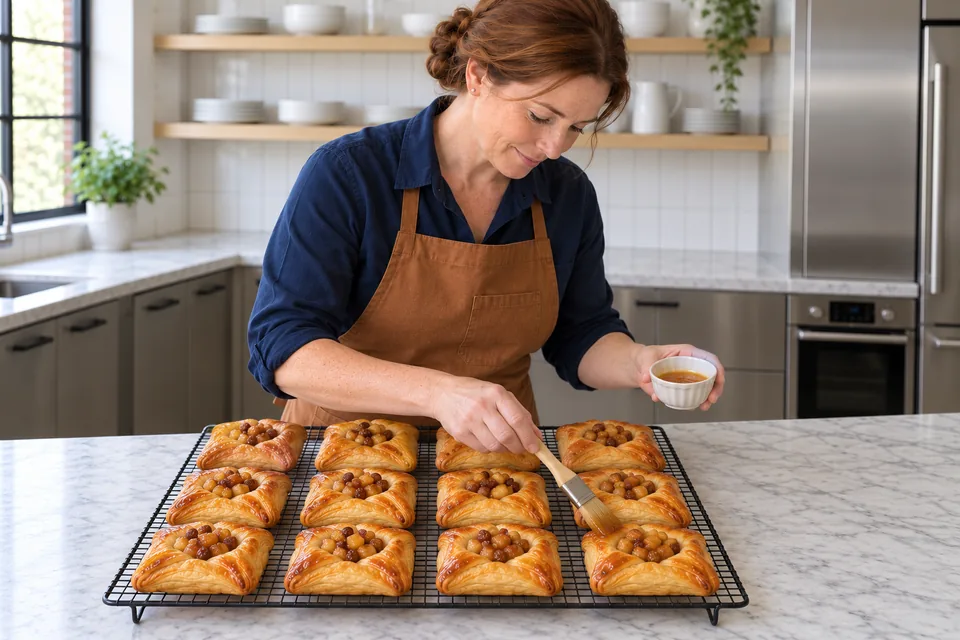
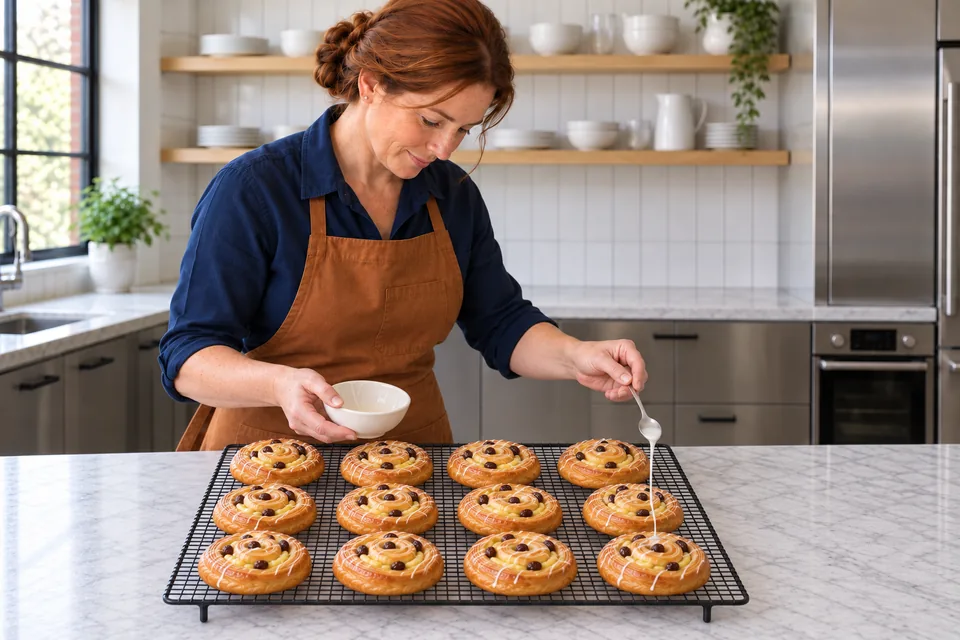
    Cook brushing a light apricot glaze over the last of twelve baked pastries.
    08 Glaze lightly and coolBrush with a thin apricot glaze and cool before serving.

What to look for

StageLook / feel forNeeds attention
Mix the dough and chillNo dry flour remains; the chilled dough is cool and firm without being frozen.
Enclose the layering butterOne complete butter block is sealed inside the dough, with no exposed butter. Dough and butter feel similarly pliable.
Make three letter turns and chill overnightAfter three letter folds the packet is neat and cool, with the butter still enclosed. No extra butter is added during the turns.
Cook and chill the apple fillingThe filling is soft but holds a spoonful without a puddle of juice. It must be cold before touching the pastry.
Cut twelve squares and fillThere are twelve pastries with clear folded corners and compact centres. Filling does not run onto the cut edges.
Proof gently and heat the ovenThe pastries are visibly fuller and light-looking, with distinct layered edges and no pool of melted butter.
Brush and bake one tray at a timeThe pastry is golden on top and underneath, with set layers around the filling rather than a wet dough band.
Glaze and coolThe glaze makes a light sheen and the pastry centre is set; the apple filling is warm rather than scalding.

Troubleshooting

If you see thisLikely causeWhat to do nowNext time
Butter breaks into hard pieces while rolling.The butter is colder and firmer than the dough.Pause briefly until the packet becomes pliable, then roll gently.Match the firmness of butter and dough before enclosing.
Butter smears out through the dough.The packet warmed too much or was pressed too hard.Cover and refrigerate until firm, then continue gently.Work in a cool room and keep the inter-turn chilling periods.
The centre stays wet.The filling was too watery or the pastry was underbaked.Return to the oven until the surrounding dough and base are set, shielding the top if needed.Cook away loose filling liquid, use it cold and check the pastry base.

Storage: Best on the day. Once cool, refrigerate in a covered container for up to 2 days. Reheat at 160°C conventional for 8–10 minutes to refresh the pastry. Freeze cooled pastries for up to 1 month and thaw in the refrigerator before reheating.; Contains: wheat, milk, egg, sulphites if present in the dried fruit.; This Nepedia version has not been kitchen-tested.

Ingredient choices & substitutions

No brand is specified.

Match the ingredient’s function and weight. See the flour, gluten, yeast and salt guide.

Other approaches to this recipe
Cook / recipeUseWhat differs

The working ingredients and method form one recipe. Different formulas are compared without averaging their quantities or rise schedules.
Nepedia

Recipe

Apple and sultana Danish pastries

Yeast pastry layered with butter, folded around a soft apple-and-sultana centre and brushed with apricot glaze. Start the dough the day before and keep it cool while rolling.

How do I make it?

  1. Mix the dough and chill

    65–70 min

    Mix the dough flour, sugar, salt and yeast. Rub in the 14 g dough butter, then add the cold milk, water and dough egg. Mix and knead gently for 3–5 minutes, until cohesive but still slightly tacky. Flatten into a thick rectangle, wrap and refrigerate for 1 hour.

    Cook unwrapping a chilled rectangle of enriched Danish dough.
    Mix a cohesive dough, wrap and chill until cool and firm.

    Ready when: No dry flour remains; the chilled dough is cool and firm without being frozen.

  2. Enclose the layering butter

    10–15 min

    Between two sheets of baking paper, pound the 213 g layering butter into a 15 cm square. It should bend under pressure without cracking or becoming greasy. Lightly flour the worktop and roll the dough to 16×32 cm. Put the butter on one half, leaving a narrow border; fold the empty half over and pinch the edges shut.

    Hands folding the empty half of the dough over one butter square.
    Enclose the single pliable butter block and seal the dough edges.

    Ready when: One complete butter block is sealed inside the dough, with no exposed butter. Dough and butter feel similarly pliable.

  3. Make three letter turns and chill overnight

    560–805 min

    Roll the packet gently to 20×45 cm. Brush off loose flour. Fold one short end over the middle third, then the other end over it, like a letter. Wrap and chill for 30 minutes. Turn the packet 90 degrees and repeat this rolling, folding and 30 minute chill once. Turn it again and make a third letter fold in the same way. Wrap securely and refrigerate for 8–12 hours. Chill earlier if butter starts to soften or escape.

    Hands completing a letter fold in one cool laminated dough sheet.
    Give three letter turns with chilling, then rest overnight.

    Ready when: After three letter folds the packet is neat and cool, with the butter still enclosed. No extra butter is added during the turns.

  4. Cook and chill the apple filling

    15–45 min

    While the dough chills, cook the apple, filling sugar, cinnamon and filling water in a small saucepan over gentle heat for 8–12 minutes, stirring until the pieces soften and loose liquid evaporates. Stir in the sultanas. Spread in a shallow container, cool promptly, then cover and refrigerate until needed.

    A compact spoonful of cooled apple-and-sultana filling above its shallow container.
    Cook away loose liquid, add sultanas and chill the filling.

    Ready when: The filling is soft but holds a spoonful without a puddle of juice. It must be cold before touching the pastry.

  5. Cut twelve squares and fill

    15–20 min

    Line two 30×40 cm trays. On a lightly floured surface, roll the dough to 30×40 cm, about 6 mm thick. Trim only ragged edges if needed, then cut a three-by-four grid of 10 cm squares. Fold each corner toward the centre and press the overlapping tips together. Place six pastries on each tray. Divide 300 g of the cold filling between the centres, 25 g each; keep any extra filling separately.

    Twelve folded raw Danish pastries with apple-and-sultana centres on two trays.
    Fold the corners and add 25 g of cold filling to each centre.

    Ready when: There are twelve pastries with clear folded corners and compact centres. Filling does not run onto the cut edges.

  6. Proof gently and heat the oven

    60–90 min

    Cover loosely and leave at 20–24°C for 60–90 minutes. Keep them away from direct heat so the butter stays inside the layers. Heat the oven to 200°C conventional during the final 20 minutes. When both trays are puffy, refrigerate the second tray while the first bakes.

    Cook uncovering twelve puffy filled Danish pastries.
    Proof gently until fuller, with the butter kept inside the layers.

    Ready when: The pastries are visibly fuller and light-looking, with distinct layered edges and no pool of melted butter.

  7. Brush and bake one tray at a time

    38–47 min

    Mix the separate wash egg and water. Brush exposed dough lightly, avoiding the cut layered edges. Bake the first tray for 18–22 minutes, then bake the second for the same range. Lift a pastry carefully to check its base.

    Cook using oven gloves to support a tray of six baked apple Danish pastries.
    Brush exposed dough and bake one tray at a time until golden underneath.

    Ready when: The pastry is golden on top and underneath, with set layers around the filling rather than a wet dough band.

  8. Glaze and cool

    30–35 min

    Warm the apricot jam with its glaze water until smooth. Brush a thin layer over each warm pastry and move it onto a rack. Cool for at least 30 minutes before serving.

    Cook brushing a light apricot glaze over the last of twelve baked pastries.
    Brush with a thin apricot glaze and cool before serving.

    Ready when: The glaze makes a light sheen and the pastry centre is set; the apple filling is warm rather than scalding.

What can go wrong, and how can I fix it?

What you noticeLikely causeWhat to do
Butter breaks into hard pieces while rolling.The butter is colder and firmer than the dough.Pause briefly until the packet becomes pliable, then roll gently. Match the firmness of butter and dough before enclosing.
Butter smears out through the dough.The packet warmed too much or was pressed too hard.Cover and refrigerate until firm, then continue gently. Work in a cool room and keep the inter-turn chilling periods.
The centre stays wet.The filling was too watery or the pastry was underbaked.Return to the oven until the surrounding dough and base are set, shielding the top if needed. Cook away loose filling liquid, use it cold and check the pastry base.
Useful recipe notes

Storage: Best on the day. Once cool, refrigerate in a covered container for up to 2 days. Reheat at 160°C conventional for 8–10 minutes to refresh the pastry. Freeze cooled pastries for up to 1 month and thaw in the refrigerator before reheating.

Contains: wheat, milk, egg, sulphites if present in the dried fruit.

This Nepedia version has not been kitchen-tested.

See the detailed method and ratios in , or follow ingredients through the .

Ingredient proportions & recipe details

Apple and sultana Danish pastries at a glance

Makes
12 pastries
Heat
200°C conventional
Baking time
18–22 min per tray;36–44 min for two trays
Cuisine / style
Denmark
Leavening
Yeast
How do the ingredient proportions compare?

Percentages compare each listed weight with the combined flour weight (100%). These are ingredient ratios, not dough hydration; milk, eggs and fillings contain other ingredients as well as water.

Formula componentGramsFlour = 100%
Plain flour330 g100%
Granulated sugar33.5 g10.2%
Fine salt7.5 g2.3%
Instant dried yeast6 g1.8%
Unsalted butter for the dough14 g4.2%
Whole milk113.5 g34.4%
Water45 g13.6%
Beaten whole egg50 g15.2%
Unsalted butter for layering213 g64.5%

Strawberry-yogurt Danish fingers

Makes
8 fingers
Heat
200°C conventional
Baking time
25–30 min per tray; 50–60 min total
Cuisine / style
France

200°C conventional; bake one tray at a time and hold the second ready tray refrigerated.

France · Danish pastry

Strawberry-yogurt Danish fingers

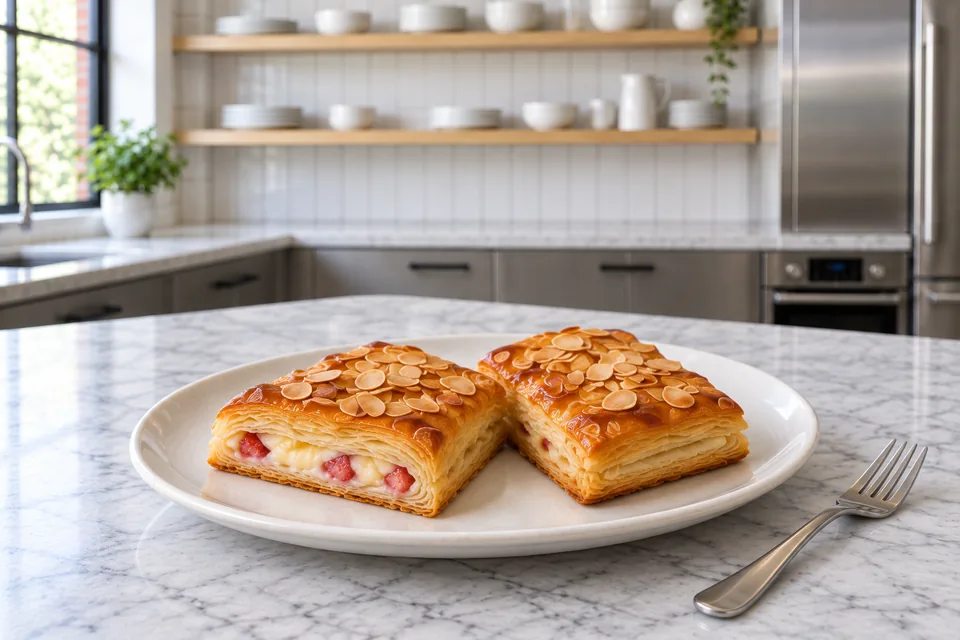
Two folded Danish strips hold strawberries, yogurt and vanilla custard beneath an almond topping. Cut them into eight fingers after baking and cooling.

Method

  1. 01 · Mix and chill the base dough

    65–70 min

    Use: Plain flour; Granulated sugar; Fine salt; Instant dried yeast; Unsalted butter for the dough; Whole milk; Water; Beaten whole egg

    Mix the dough flour, sugar, salt and yeast. Rub in the 14 g dough butter, then add the cold milk, water and dough egg. Mix and knead gently for 3–5 minutes, until cohesive but still slightly tacky. Flatten into a thick rectangle, wrap and refrigerate for 1 hour.

    Ready when: No dry flour remains; the chilled dough is cool and firm without being frozen.

    The cook unwraps one chilled rectangle of unlaminated Danish dough.
    01 Strawberry-yogurt Danish fingersMix, wrap and chill the enriched dough until firm.
  2. 02 · Enclose the measured layering butter

    10–15 min

    Use: Unsalted butter for layering; Flour for rolling

    Between two sheets of baking paper, pound the 213 g layering butter into a 15 cm square. It should bend under pressure without cracking or becoming greasy. Lightly flour the worktop and roll the dough to 16×32 cm. Put the butter on one half, leaving a narrow border; fold the empty half over and pinch the edges shut.

    Ready when: One complete butter block is sealed inside the dough, with no exposed butter. Dough and butter feel similarly pliable.

    Hands fold one dough half over a single square of layering butter.
    02 Strawberry-yogurt Danish fingersEnclose the single butter block and seal the edges.
  3. 03 · Make three letter turns and chill overnight

    560–805 min

    Use: Flour for rolling

    Roll the packet gently to 20×45 cm. Brush off loose flour. Fold one short end over the middle third, then the other end over it, like a letter. Wrap and chill for 30 minutes. Turn the packet 90 degrees and repeat this rolling, folding and 30 minute chill once. Turn it again and make a third letter fold in the same way. Wrap securely and refrigerate for 8–12 hours. Chill earlier if butter starts to soften or escape.

    Ready when: After three letter folds the packet is neat and cool, with the butter still enclosed. No extra butter is added during the turns.

    The cook completes a letter fold in one cool laminated dough packet.
    03 Strawberry-yogurt Danish fingersComplete three letter turns with chilling, then rest overnight.
  4. 04 · Cook and thoroughly chill a separate custard batch

    255–265 min

    Use: Whole milk for the custard; Sugar for the custard; Cornflour; Egg yolk; Unsalted butter for the custard; Vanilla seeds

    Make the custard while the dough has its long refrigerator rest. Heat the 150 g custard milk until steaming. In a bowl, whisk the 30 g custard sugar, cornflour and yolk until smooth. Gradually whisk in the hot milk, then return to the saucepan. Cook over medium heat, whisking constantly, until bubbles break through the centre; continue whisking for 1 minute. Remove from the heat and stir in the 10 g custard butter and vanilla seeds. Spread in a shallow container, cover the surface and refrigerate promptly for at least 4 hours, until completely cold.

    Ready when: The custard is smooth, thick and cold, with no raw starch taste or loose liquid.

    A small batch of thick vanilla custard is uncovered after chilling.
    04 Strawberry-yogurt Danish fingersCook the vanilla custard and chill until completely cold.
  5. 05 · Select custard and shape two folded strips

    20–25 min

    Use: Flour for rolling; Prepared strawberries; Full-fat strained plain Greek yogurt

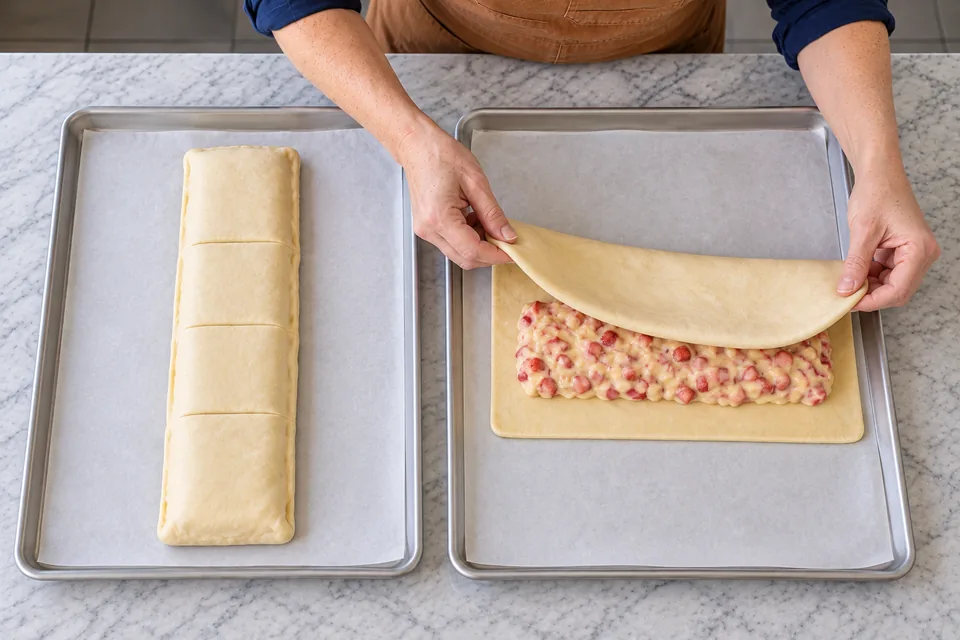
    Line two 30×40 cm trays. On a lightly floured worktop, roll the dough to 30×40 cm, about 6 mm thick. Cut across the 40 cm length to make two 30×20 cm rectangles. Beat 180 g of the cold custard smooth, then fold in the 60 g yogurt and 120 g dry diced strawberries; keep any extra custard separately. Divide this 360 g filling equally between the rectangles. Spread each 180 g portion in a 6 cm-wide band along one 30 cm half, leaving about 2 cm clear at the long edge and ends. Fold the empty half over the filling to make a 30×10 cm strip, then press the open edges gently shut. Place one strip on each tray. Mark three shallow lines across each top at 7.5 cm intervals without cutting into the filling.

    Ready when: There are two sealed strips, each marked into four fingers, with no filling on the outer seams.

    One sealed strip rests beside the second strawberry-custard rectangle being folded.
    05 Strawberry-yogurt Danish fingersDivide the filling between two rectangles, fold and mark each strip.
  6. 06 · Proof; keep the second ready tray cold

    60–90 min

    Use:

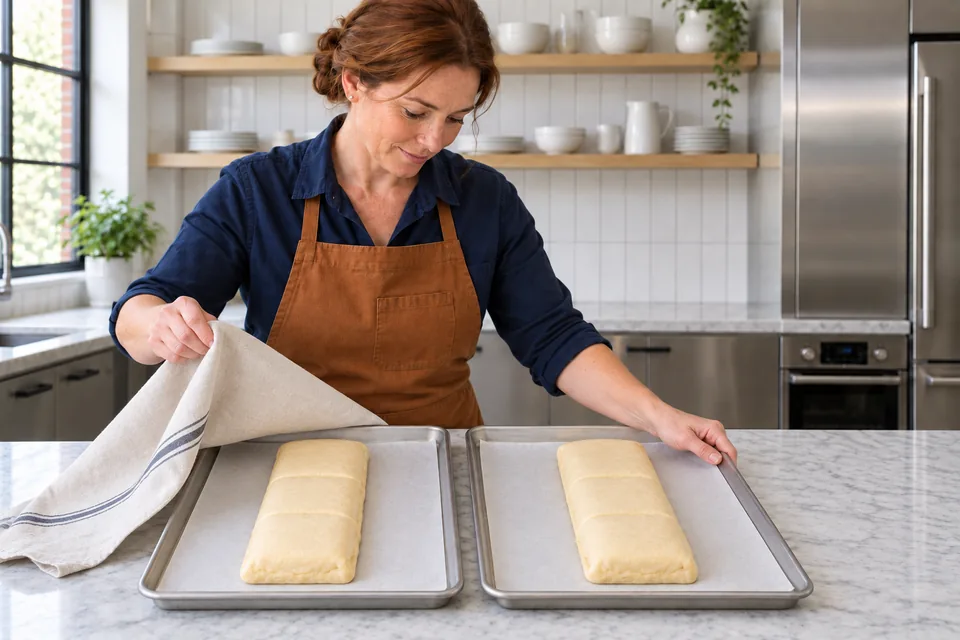
    Cover loosely and leave at 20–24°C for 60–90 minutes, away from direct heat. Heat the oven to 200°C conventional during the final 20 minutes. When both trays are puffy, refrigerate the second while the first bakes.

    Ready when: The pastry is visibly aerated and the butter remains inside the layers.

    Two filled Danish strips proof on separate trays, each marked into four portions.
    06 Strawberry-yogurt Danish fingersProof the two sealed strips until puffy.
  7. 07 · Brush and bake both trays sequentially

    52–63 min

    Use: Beaten egg for brushing; Water for the egg wash; Flaked almonds

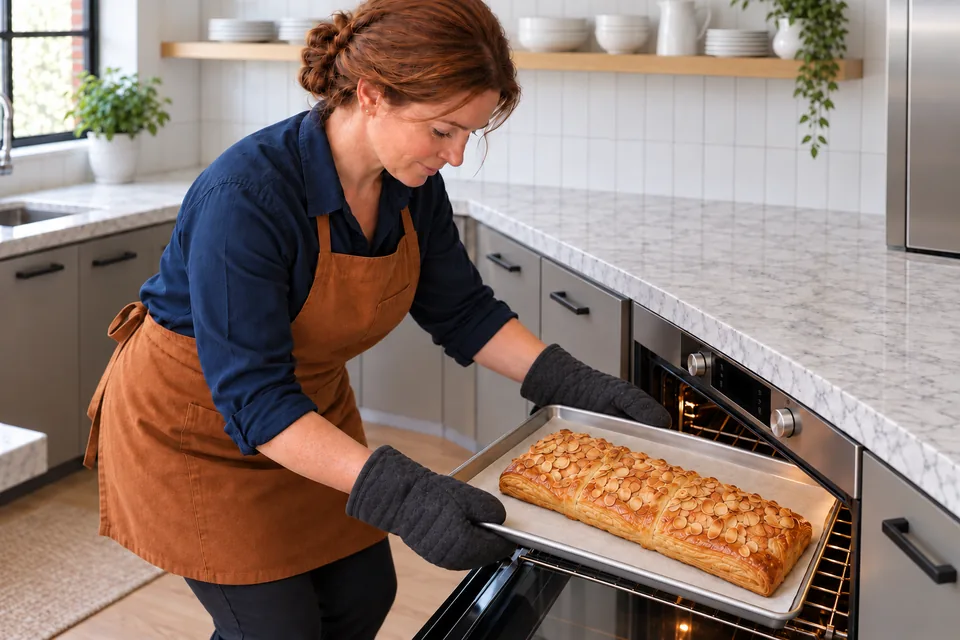
    Mix the wash egg and water. Brush exposed dough lightly, avoiding the cut layered edges. Scatter the almonds evenly over the two strips. Bake the first tray for 25–30 minutes, then bake the second for the same range. Lift a pastry carefully to inspect the base; cover loosely with foil if the top colours before the base is cooked.

    Ready when: The tops and bases are golden, the visible pastry layers are dry and set, and there is no pale wet dough beside the filling.

    The cook supports one tray holding a golden almond-topped Danish strip.
    07 Strawberry-yogurt Danish fingersBrush, add the almonds and bake one tray at a time.
  8. 08 · Glaze, cool and cut eight fingers

    35–40 min

    Use: Smooth apricot jam; Water for the glaze

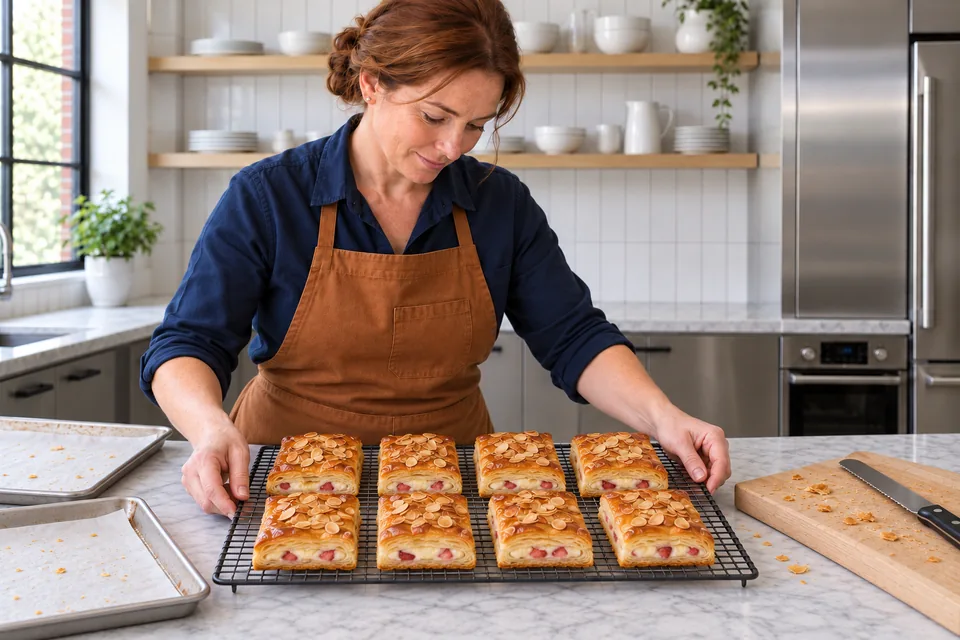
    Warm the apricot jam with its glaze water until smooth. Brush a thin layer over the warm pastries and move to racks. Cool for at least 30 minutes. Cut each strip along its marks into four fingers, eight pieces total.

    Ready when: The layers are set and the filling is no longer hot. Each strip yields four neat fingers.

    Eight cooled almond-topped Danish fingers show set strawberry-custard filling.
    08 Strawberry-yogurt Danish fingersGlaze, cool and cut each strip into four fingers.

What to look for

StageLook / feel forNeeds attention
Mix and chill the base doughNo dry flour remains; the chilled dough is cool and firm without being frozen.
Enclose the measured layering butterOne complete butter block is sealed inside the dough, with no exposed butter. Dough and butter feel similarly pliable.
Make three letter turns and chill overnightAfter three letter folds the packet is neat and cool, with the butter still enclosed. No extra butter is added during the turns.
Cook and thoroughly chill a separate custard batchThe custard is smooth, thick and cold, with no raw starch taste or loose liquid.
Select custard and shape two folded stripsThere are two sealed strips, each marked into four fingers, with no filling on the outer seams.
Proof; keep the second ready tray coldThe pastry is visibly aerated and the butter remains inside the layers.
Brush and bake both trays sequentiallyThe tops and bases are golden, the visible pastry layers are dry and set, and there is no pale wet dough beside the filling.
Glaze, cool and cut eight fingersThe layers are set and the filling is no longer hot. Each strip yields four neat fingers.

Troubleshooting

If you see thisLikely causeWhat to do nowNext time
Butter leaks while rolling.The dough or butter is too warm.Stop, wrap and chill until cool but pliable.Use short rolling sessions and keep the packet cool.
The pastry beside the filling stays pale and wet.The filling was warm or loose, or baking stopped early.Cover the browned top loosely and continue until the base and inner dough are set.Use cold thick custard and the stated filling weight; inspect the base before removing.

Storage: Refrigerate covered within 2 hours of baking and use within 1 day. Keep unused custard refrigerated and use within 2 days. Reheat pastry portions until hot through if serving warm.; Contains: wheat, milk, egg, almonds.; This Nepedia version has not been kitchen-tested.

Ingredient choices & substitutions

No brand is specified.

Match the ingredient’s function and weight. See the flour, gluten, yeast and salt guide.

Other approaches to this recipe
Cook / recipeUseWhat differs

The working ingredients and method form one recipe. Different formulas are compared without averaging their quantities or rise schedules.
Nepedia
Two almond-topped Danish fingers show crisp layers and set strawberry-custard filling.
Strawberry-yogurt Danish fingers, cooled and lightly glazed.

Recipe

Strawberry-yogurt Danish fingers

Two folded Danish strips hold strawberries, yogurt and vanilla custard beneath an almond topping. Cut them into eight fingers after baking and cooling.

How do I make it?

  1. Mix and chill the base dough

    65–70 min

    Mix the dough flour, sugar, salt and yeast. Rub in the 14 g dough butter, then add the cold milk, water and dough egg. Mix and knead gently for 3–5 minutes, until cohesive but still slightly tacky. Flatten into a thick rectangle, wrap and refrigerate for 1 hour.

    The cook unwraps one chilled rectangle of unlaminated Danish dough.
    Mix, wrap and chill the enriched dough until firm.

    Ready when: No dry flour remains; the chilled dough is cool and firm without being frozen.

  2. Enclose the measured layering butter

    10–15 min

    Between two sheets of baking paper, pound the 213 g layering butter into a 15 cm square. It should bend under pressure without cracking or becoming greasy. Lightly flour the worktop and roll the dough to 16×32 cm. Put the butter on one half, leaving a narrow border; fold the empty half over and pinch the edges shut.

    Hands fold one dough half over a single square of layering butter.
    Enclose the single butter block and seal the edges.

    Ready when: One complete butter block is sealed inside the dough, with no exposed butter. Dough and butter feel similarly pliable.

  3. Make three letter turns and chill overnight

    560–805 min

    Roll the packet gently to 20×45 cm. Brush off loose flour. Fold one short end over the middle third, then the other end over it, like a letter. Wrap and chill for 30 minutes. Turn the packet 90 degrees and repeat this rolling, folding and 30 minute chill once. Turn it again and make a third letter fold in the same way. Wrap securely and refrigerate for 8–12 hours. Chill earlier if butter starts to soften or escape.

    The cook completes a letter fold in one cool laminated dough packet.
    Complete three letter turns with chilling, then rest overnight.

    Ready when: After three letter folds the packet is neat and cool, with the butter still enclosed. No extra butter is added during the turns.

  4. Cook and thoroughly chill a separate custard batch

    255–265 min

    Make the custard while the dough has its long refrigerator rest. Heat the 150 g custard milk until steaming. In a bowl, whisk the 30 g custard sugar, cornflour and yolk until smooth. Gradually whisk in the hot milk, then return to the saucepan. Cook over medium heat, whisking constantly, until bubbles break through the centre; continue whisking for 1 minute. Remove from the heat and stir in the 10 g custard butter and vanilla seeds. Spread in a shallow container, cover the surface and refrigerate promptly for at least 4 hours, until completely cold.

    A small batch of thick vanilla custard is uncovered after chilling.
    Cook the vanilla custard and chill until completely cold.

    Ready when: The custard is smooth, thick and cold, with no raw starch taste or loose liquid.

  5. Select custard and shape two folded strips

    20–25 min

    Line two 30×40 cm trays. On a lightly floured worktop, roll the dough to 30×40 cm, about 6 mm thick. Cut across the 40 cm length to make two 30×20 cm rectangles. Beat 180 g of the cold custard smooth, then fold in the 60 g yogurt and 120 g dry diced strawberries; keep any extra custard separately. Divide this 360 g filling equally between the rectangles. Spread each 180 g portion in a 6 cm-wide band along one 30 cm half, leaving about 2 cm clear at the long edge and ends. Fold the empty half over the filling to make a 30×10 cm strip, then press the open edges gently shut. Place one strip on each tray. Mark three shallow lines across each top at 7.5 cm intervals without cutting into the filling.

    One sealed strip rests beside the second strawberry-custard rectangle being folded.
    Divide the filling between two rectangles, fold and mark each strip.

    Ready when: There are two sealed strips, each marked into four fingers, with no filling on the outer seams.

  6. Proof; keep the second ready tray cold

    60–90 min

    Cover loosely and leave at 20–24°C for 60–90 minutes, away from direct heat. Heat the oven to 200°C conventional during the final 20 minutes. When both trays are puffy, refrigerate the second while the first bakes.

    Two filled Danish strips proof on separate trays, each marked into four portions.
    Proof the two sealed strips until puffy.

    Ready when: The pastry is visibly aerated and the butter remains inside the layers.

  7. Brush and bake both trays sequentially

    52–63 min

    Mix the wash egg and water. Brush exposed dough lightly, avoiding the cut layered edges. Scatter the almonds evenly over the two strips. Bake the first tray for 25–30 minutes, then bake the second for the same range. Lift a pastry carefully to inspect the base; cover loosely with foil if the top colours before the base is cooked.

    The cook supports one tray holding a golden almond-topped Danish strip.
    Brush, add the almonds and bake one tray at a time.

    Ready when: The tops and bases are golden, the visible pastry layers are dry and set, and there is no pale wet dough beside the filling.

  8. Glaze, cool and cut eight fingers

    35–40 min

    Warm the apricot jam with its glaze water until smooth. Brush a thin layer over the warm pastries and move to racks. Cool for at least 30 minutes. Cut each strip along its marks into four fingers, eight pieces total.

    Eight cooled almond-topped Danish fingers show set strawberry-custard filling.
    Glaze, cool and cut each strip into four fingers.

    Ready when: The layers are set and the filling is no longer hot. Each strip yields four neat fingers.

What can go wrong, and how can I fix it?

What you noticeLikely causeWhat to do
Butter leaks while rolling.The dough or butter is too warm.Stop, wrap and chill until cool but pliable. Use short rolling sessions and keep the packet cool.
The pastry beside the filling stays pale and wet.The filling was warm or loose, or baking stopped early.Cover the browned top loosely and continue until the base and inner dough are set. Use cold thick custard and the stated filling weight; inspect the base before removing.
Useful recipe notes

Storage: Refrigerate covered within 2 hours of baking and use within 1 day. Keep unused custard refrigerated and use within 2 days. Reheat pastry portions until hot through if serving warm.

Contains: wheat, milk, egg, almonds.

This Nepedia version has not been kitchen-tested.

See the detailed method and ratios in , or follow ingredients through the .

Ingredient proportions & recipe details

Strawberry-yogurt Danish fingers at a glance

Makes
8 fingers
Heat
200°C conventional
Baking time
25–30 min per tray; 50–60 min total
Cuisine / style
France
Leavening
Yeast
How do the ingredient proportions compare?

Percentages compare each listed weight with the combined flour weight (100%). These are ingredient ratios, not dough hydration; milk, eggs and fillings contain other ingredients as well as water.

Formula componentGramsFlour = 100%
Plain flour330 g100%
Granulated sugar33.5 g10.2%
Fine salt7.5 g2.3%
Instant dried yeast6 g1.8%
Unsalted butter for the dough14 g4.2%
Whole milk113.5 g34.4%
Water45 g13.6%
Beaten whole egg50 g15.2%
Unsalted butter for layering213 g64.5%

Pains aux raisins

Makes
12 pastries
Heat
200°C conventional
Baking time
22–25 min per tray; 44–50 min total
Cuisine / style
France

200°C conventional; bake one tray at a time and hold the second ready tray refrigerated.

France · Danish pastry

Pains aux raisins

Laminated Danish spirals with vanilla custard, soft raisins and cinnamon, finished with apricot glaze and a light lemon icing.

Method

  1. 01 · Mix and chill the base dough

    65–70 min

    Use: Plain flour; Granulated sugar; Fine salt; Instant dried yeast; Unsalted butter for the dough; Whole milk; Water; Beaten whole egg

    Mix the dough flour, sugar, salt and yeast. Rub in the 14 g dough butter, then add the cold milk, water and dough egg. Mix and knead gently for 3–5 minutes, until cohesive but still slightly tacky. Flatten into a thick rectangle, wrap and refrigerate for 1 hour.

    Ready when: No dry flour remains; the chilled dough is cool and firm without being frozen.

    The cook unwraps one modest rectangle of chilled Danish dough.
    01 Pains aux raisinsMix, wrap and chill a cohesive dough before adding the layering butter.
  2. 02 · Enclose the measured layering butter

    10–15 min

    Use: Unsalted butter for layering; Flour for rolling

    Between two sheets of baking paper, pound the 213 g layering butter into a 15 cm square. It should bend under pressure without cracking or becoming greasy. Lightly flour the worktop and roll the dough to 16×32 cm. Put the butter on one half, leaving a narrow border; fold the empty half over and pinch the edges shut.

    Ready when: One complete butter block is sealed inside the dough, with no exposed butter. Dough and butter feel similarly pliable.

    Hands enclose one small butter square inside the chilled dough.
    02 Pains aux raisinsFold the dough over the single butter block and seal the edges.
  3. 03 · Make three letter turns and chill overnight

    560–805 min

    Use: Flour for rolling

    Roll the packet gently to 20×45 cm. Brush off loose flour. Fold one short end over the middle third, then the other end over it, like a letter. Wrap and chill for 30 minutes. Turn the packet 90 degrees and repeat this rolling, folding and 30 minute chill once. Turn it again and make a third letter fold in the same way. Wrap securely and refrigerate for 8–12 hours. Chill earlier if butter starts to soften or escape.

    Ready when: After three letter folds the packet is neat and cool, with the butter still enclosed. No extra butter is added during the turns.

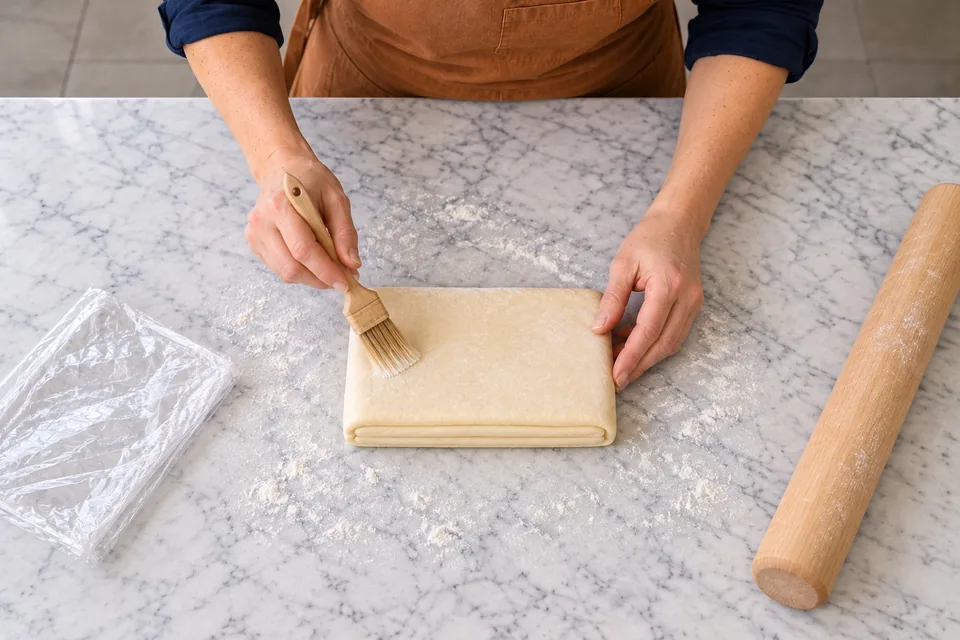
    The cook brushes loose flour from one cool letter-folded laminated dough packet.
    03 Pains aux raisinsGive three letter turns with chilling, then rest the pastry overnight.
  4. 04 · Cook and thoroughly chill a separate custard batch

    255–265 min

    Use: Whole milk for the custard; Sugar for the custard; Cornflour; Egg yolk; Unsalted butter for the custard; Vanilla seeds

    Make the custard while the dough has its long refrigerator rest. Heat the 150 g custard milk until steaming. In a bowl, whisk the 30 g custard sugar, cornflour and yolk until smooth. Gradually whisk in the hot milk, then return to the saucepan. Cook over medium heat, whisking constantly, until bubbles break through the centre; continue whisking for 1 minute. Remove from the heat and stir in the 10 g custard butter and vanilla seeds. Spread in a shallow container, cover the surface and refrigerate promptly for at least 4 hours, until completely cold.

    Ready when: The custard is smooth, thick and cold, with no raw starch taste or loose liquid.

    A small shallow container of thick vanilla custard is uncovered after chilling.
    04 Pains aux raisinsCook the custard until thick, then cover and chill completely.
  5. 05 · Select custard and shape twelve spirals

    50–60 min

    Use: Flour for rolling; Soft raisins; Ground cinnamon

    Line two 30×40 cm trays. Roll the cold dough to 30×40 cm, about 6 mm thick, using light flour dustings. Beat 200 g of the cold custard smooth and spread it over the sheet, leaving a 2 cm bare strip along one 40 cm edge. Keep extra custard separately. Scatter over all the raisins and cinnamon. Roll from the opposite 40 cm edge into a 40 cm log and pinch the bare edge closed. Wrap and chill for 30 minutes. Cut into 12 equal slices, about 3.3 cm thick. Set cut-side up, six per tray, and gently flatten to about 2.5 cm high, leaving space to rise.

    Ready when: There are 12 even spirals with a thin custard layer and raisins distributed through them.

    Twelve small raw raisin-and-custard spirals sit on two lined trays.
    05 Pains aux raisinsCut twelve even spirals and arrange six on each tray.
  6. 06 · Proof; keep the second ready tray cold

    60–90 min

    Use:

    Cover loosely and leave at 20–24°C for 60–90 minutes, away from direct heat. Heat the oven to 200°C conventional during the final 20 minutes. When both trays are puffy, refrigerate the second while the first bakes.

    Ready when: The pastry is visibly aerated and the butter remains inside the layers.

    The cook uncovers twelve proofed raisin Danish spirals on two trays.
    06 Pains aux raisinsLet the spirals become puffy while keeping the butter cool.
  7. 07 · Brush and bake both trays sequentially

    46–53 min

    Use: Beaten egg for brushing; Water for the egg wash

    Mix the wash egg and water. Brush exposed dough lightly, avoiding the cut layered edges. Bake the first tray for 22–25 minutes, then bake the second for the same range. Lift a pastry carefully to inspect the base; cover loosely with foil if the top colours before the base is cooked.

    Ready when: The tops and bases are golden, the visible pastry layers are dry and set, and there is no pale wet dough beside the filling.

    The cook checks the browned base of one of six baked raisin spirals.
    07 Pains aux raisinsBake one tray at a time until the tops, bases and layers are set.
  8. 08 · Glaze, cool and drizzle the separate icing

    45–50 min

    Use: Smooth apricot jam; Water for the glaze; Icing sugar; Water for icing; Finely grated lemon zest

    Warm the apricot jam with its glaze water until smooth. Brush a thin layer over the warm pastries and move to racks. Cool for at least 30 minutes. Mix the icing sugar, icing water and lemon zest into a thin icing. Drizzle evenly over the cooled pastries and leave for 10 minutes to begin setting.

    Ready when: The layers are set and the filling is no longer hot. The clear jam glaze has a light white icing drizzle.

    Twelve golden raisin spirals on a rack have a thin glaze and light white icing.
    08 Pains aux raisinsGlaze, cool and finish the pastries with a light lemon icing drizzle.

What to look for

StageLook / feel forNeeds attention
Mix and chill the base doughNo dry flour remains; the chilled dough is cool and firm without being frozen.
Enclose the measured layering butterOne complete butter block is sealed inside the dough, with no exposed butter. Dough and butter feel similarly pliable.
Make three letter turns and chill overnightAfter three letter folds the packet is neat and cool, with the butter still enclosed. No extra butter is added during the turns.
Cook and thoroughly chill a separate custard batchThe custard is smooth, thick and cold, with no raw starch taste or loose liquid.
Select custard and shape twelve spiralsThere are 12 even spirals with a thin custard layer and raisins distributed through them.
Proof; keep the second ready tray coldThe pastry is visibly aerated and the butter remains inside the layers.
Brush and bake both trays sequentiallyThe tops and bases are golden, the visible pastry layers are dry and set, and there is no pale wet dough beside the filling.
Glaze, cool and drizzle the separate icingThe layers are set and the filling is no longer hot. The clear jam glaze has a light white icing drizzle.

Troubleshooting

If you see thisLikely causeWhat to do nowNext time
Butter leaks while rolling.The dough or butter is too warm.Stop, wrap and chill until cool but pliable.Use short rolling sessions and keep the packet cool.
The pastry beside the filling stays pale and wet.The filling was warm or loose, or baking stopped early.Cover the browned top loosely and continue until the base and inner dough are set.Use cold thick custard and the stated filling weight; inspect the base before removing.

Storage: Refrigerate covered within 2 hours of baking and use within 1 day. Keep unused custard refrigerated and use within 2 days. Reheat pastry portions until hot through if serving warm.; Contains: wheat, milk, egg, sulphites if present in the raisins.; This Nepedia version has not been kitchen-tested.

Ingredient choices & substitutions

No brand is specified.

Match the ingredient’s function and weight. See the flour, gluten, yeast and salt guide.

Other approaches to this recipe
Cook / recipeUseWhat differs

The working ingredients and method form one recipe. Different formulas are compared without averaging their quantities or rise schedules.
Nepedia
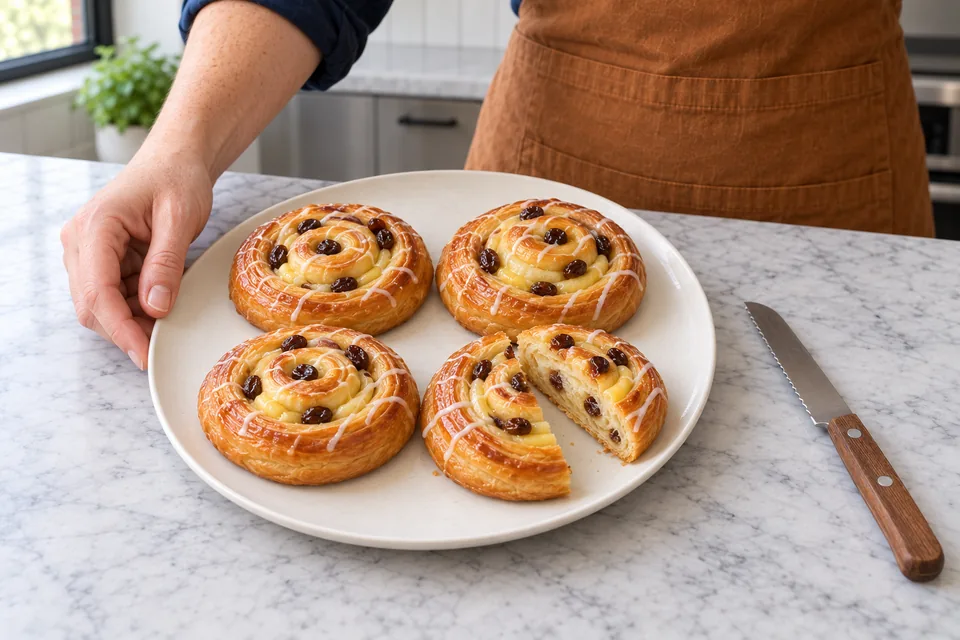
Three small iced raisin spirals and a split fourth pastry show the laminated layers and custard filling.
Pains aux raisins with custard, apricot glaze and a light lemon icing.

Recipe

Pains aux raisins

Laminated Danish spirals with vanilla custard, soft raisins and cinnamon, finished with apricot glaze and a light lemon icing.

How do I make it?

  1. Mix and chill the base dough

    65–70 min

    Mix the dough flour, sugar, salt and yeast. Rub in the 14 g dough butter, then add the cold milk, water and dough egg. Mix and knead gently for 3–5 minutes, until cohesive but still slightly tacky. Flatten into a thick rectangle, wrap and refrigerate for 1 hour.

    The cook unwraps one modest rectangle of chilled Danish dough.
    Mix, wrap and chill a cohesive dough before adding the layering butter.

    Ready when: No dry flour remains; the chilled dough is cool and firm without being frozen.

  2. Enclose the measured layering butter

    10–15 min

    Between two sheets of baking paper, pound the 213 g layering butter into a 15 cm square. It should bend under pressure without cracking or becoming greasy. Lightly flour the worktop and roll the dough to 16×32 cm. Put the butter on one half, leaving a narrow border; fold the empty half over and pinch the edges shut.

    Hands enclose one small butter square inside the chilled dough.
    Fold the dough over the single butter block and seal the edges.

    Ready when: One complete butter block is sealed inside the dough, with no exposed butter. Dough and butter feel similarly pliable.

  3. Make three letter turns and chill overnight

    560–805 min

    Roll the packet gently to 20×45 cm. Brush off loose flour. Fold one short end over the middle third, then the other end over it, like a letter. Wrap and chill for 30 minutes. Turn the packet 90 degrees and repeat this rolling, folding and 30 minute chill once. Turn it again and make a third letter fold in the same way. Wrap securely and refrigerate for 8–12 hours. Chill earlier if butter starts to soften or escape.

    The cook brushes loose flour from one cool letter-folded laminated dough packet.
    Give three letter turns with chilling, then rest the pastry overnight.

    Ready when: After three letter folds the packet is neat and cool, with the butter still enclosed. No extra butter is added during the turns.

  4. Cook and thoroughly chill a separate custard batch

    255–265 min

    Make the custard while the dough has its long refrigerator rest. Heat the 150 g custard milk until steaming. In a bowl, whisk the 30 g custard sugar, cornflour and yolk until smooth. Gradually whisk in the hot milk, then return to the saucepan. Cook over medium heat, whisking constantly, until bubbles break through the centre; continue whisking for 1 minute. Remove from the heat and stir in the 10 g custard butter and vanilla seeds. Spread in a shallow container, cover the surface and refrigerate promptly for at least 4 hours, until completely cold.

    A small shallow container of thick vanilla custard is uncovered after chilling.
    Cook the custard until thick, then cover and chill completely.

    Ready when: The custard is smooth, thick and cold, with no raw starch taste or loose liquid.

  5. Select custard and shape twelve spirals

    50–60 min

    Line two 30×40 cm trays. Roll the cold dough to 30×40 cm, about 6 mm thick, using light flour dustings. Beat 200 g of the cold custard smooth and spread it over the sheet, leaving a 2 cm bare strip along one 40 cm edge. Keep extra custard separately. Scatter over all the raisins and cinnamon. Roll from the opposite 40 cm edge into a 40 cm log and pinch the bare edge closed. Wrap and chill for 30 minutes. Cut into 12 equal slices, about 3.3 cm thick. Set cut-side up, six per tray, and gently flatten to about 2.5 cm high, leaving space to rise.

    Twelve small raw raisin-and-custard spirals sit on two lined trays.
    Cut twelve even spirals and arrange six on each tray.

    Ready when: There are 12 even spirals with a thin custard layer and raisins distributed through them.

  6. Proof; keep the second ready tray cold

    60–90 min

    Cover loosely and leave at 20–24°C for 60–90 minutes, away from direct heat. Heat the oven to 200°C conventional during the final 20 minutes. When both trays are puffy, refrigerate the second while the first bakes.

    The cook uncovers twelve proofed raisin Danish spirals on two trays.
    Let the spirals become puffy while keeping the butter cool.

    Ready when: The pastry is visibly aerated and the butter remains inside the layers.

  7. Brush and bake both trays sequentially

    46–53 min

    Mix the wash egg and water. Brush exposed dough lightly, avoiding the cut layered edges. Bake the first tray for 22–25 minutes, then bake the second for the same range. Lift a pastry carefully to inspect the base; cover loosely with foil if the top colours before the base is cooked.

    The cook checks the browned base of one of six baked raisin spirals.
    Bake one tray at a time until the tops, bases and layers are set.

    Ready when: The tops and bases are golden, the visible pastry layers are dry and set, and there is no pale wet dough beside the filling.

  8. Glaze, cool and drizzle the separate icing

    45–50 min

    Warm the apricot jam with its glaze water until smooth. Brush a thin layer over the warm pastries and move to racks. Cool for at least 30 minutes. Mix the icing sugar, icing water and lemon zest into a thin icing. Drizzle evenly over the cooled pastries and leave for 10 minutes to begin setting.

    Twelve golden raisin spirals on a rack have a thin glaze and light white icing.
    Glaze, cool and finish the pastries with a light lemon icing drizzle.

    Ready when: The layers are set and the filling is no longer hot. The clear jam glaze has a light white icing drizzle.

What can go wrong, and how can I fix it?

What you noticeLikely causeWhat to do
Butter leaks while rolling.The dough or butter is too warm.Stop, wrap and chill until cool but pliable. Use short rolling sessions and keep the packet cool.
The pastry beside the filling stays pale and wet.The filling was warm or loose, or baking stopped early.Cover the browned top loosely and continue until the base and inner dough are set. Use cold thick custard and the stated filling weight; inspect the base before removing.
Useful recipe notes

Storage: Refrigerate covered within 2 hours of baking and use within 1 day. Keep unused custard refrigerated and use within 2 days. Reheat pastry portions until hot through if serving warm.

Contains: wheat, milk, egg, sulphites if present in the raisins.

This Nepedia version has not been kitchen-tested.

See the detailed method and ratios in , or follow ingredients through the .

Ingredient proportions & recipe details

Pains aux raisins at a glance

Makes
12 pastries
Heat
200°C conventional
Baking time
22–25 min per tray; 44–50 min total
Cuisine / style
France
Leavening
Yeast
How do the ingredient proportions compare?

Percentages compare each listed weight with the combined flour weight (100%). These are ingredient ratios, not dough hydration; milk, eggs and fillings contain other ingredients as well as water.

Formula componentGramsFlour = 100%
Plain flour330 g100%
Granulated sugar33.5 g10.2%
Fine salt7.5 g2.3%
Instant dried yeast6 g1.8%
Unsalted butter for the dough14 g4.2%
Whole milk113.5 g34.4%
Water45 g13.6%
Beaten whole egg50 g15.2%
Unsalted butter for layering213 g64.5%