All Bubbles
🚀

Planetary differentiation

space Ages 11-13+

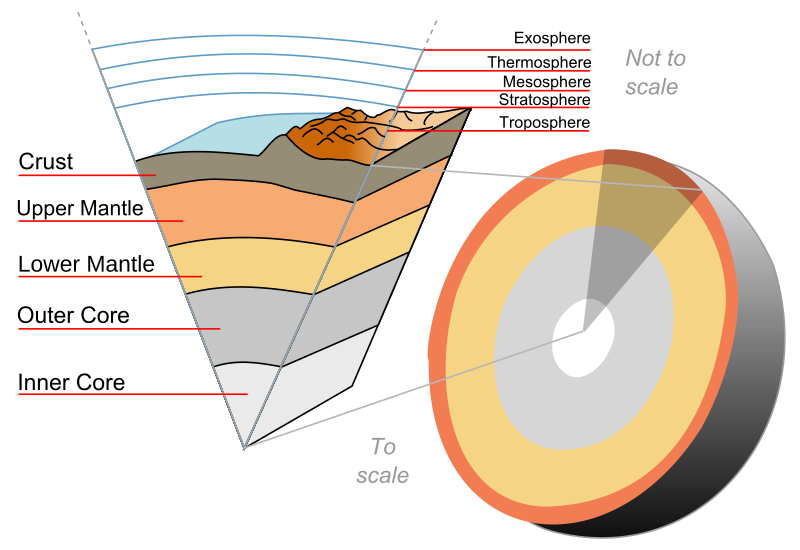
Did you know planets have layers? When Earth was very young, it was so hot that it melted. Heavy metal like iron sank to the middle. Lighter rocks floated to the top. This is why we have a hard crust to walk on!
Earth-crust-cutaway-english.svg

44 words

Long ago, planets like Earth were so hot that they melted into a liquid. This heat came from space rocks hitting the planet and from energy inside. Because the planet was liquid, gravity pulled heavy things like iron down to the center to make a core. Lighter rocks floated up to form the crust we live on.

Earth-crust-cutaway-english.svg
A "wow" fact is that our Moon was made from the light rocks that splashed off Earth during a giant crash! Because the heavy iron was already deep inside Earth, the Moon ended up with very little metal.
Earth-crust-cutaway-english.svg

97 words

Planetary differentiation is the process of a planet separating into layers. When a planet is young, it gets very hot from radioactive decay (energy from atoms breaking down) and impacts from space rocks. This heat melts the planet. Gravity then takes over, pulling heavy materials like iron toward the center to form a metallic core. Lighter materials, like silicates, stay higher up to form the mantle and the thin outer crust.

Earth-crust-cutaway-english.svg
It isn't just about weight, though. Some elements are "iron-loving" and travel down with the metal. Others prefer to stay with the light rocks. For example, even though uranium is heavy, it stays in the crust because it fits better with the chemicals there.
Earth-crust-cutaway-english.svg
This process happened on Earth, the Moon, and even large asteroids like Vesta. On Earth, we even have layers of water (the hydrosphere) and air (the atmosphere) that are the lightest of all!
Earth-crust-cutaway-english.svg

151 words

Planetary differentiation is the scientific name for how a planet separates into different layers, much like the layers of an onion. This process happens early in a planet's life when it is still hot enough to be molten or plastic. The heat comes from several sources: the energy of smaller rocks smashing into the planet as it grows (accretion), the pressure of gravity, and the decay of radioactive isotopes like Aluminum-26. When the planet becomes liquid, gravity sorts the materials by their density.

Earth-crust-cutaway-english.svg
The heaviest materials, especially iron and nickel, sink deep into the center of the planet to form a metallic core. As the iron sinks, it takes other "siderophile" (iron-loving) elements with it. Lighter materials, such as rocks called silicates, float to the top. This creates a thick layer called the mantle and a thin, outer layer called the crust. On Earth, the crust has a density of about 2700 kg/m3, while the planet as a whole has an average density of 5515 kg/m3 because the core is so heavy.
Earth-crust-cutaway-english.svg
Chemical behavior also plays a big role. Some elements are "incompatible," meaning they don't fit well into the crystals that form in the mantle. These elements get squeezed out and move toward the crust. A surprising example is uranium. Even though uranium is very dense, it is chemically more compatible with the light rocks of the crust, so that is where most of Earth's uranium is found.
Earth-crust-cutaway-english.svg
We can see the results of differentiation on other worlds too. The asteroid 4 Vesta is a great example; scientists have found meteorites from Vesta that show it once had a crust and a core just like a tiny planet. The Moon is another example. It likely formed when a giant object hit the Earth and knocked off a huge amount of light, rocky material. Because the heavy iron was already hidden in Earth's core, the Moon ended up being made mostly of light rocks. There are different ways the heavy metal reaches the center, such as percolation, where liquid metal trickles down through tiny holes in the rock, or diapirism, where large blobs of material rise or sink.
Earth-crust-cutaway-english.svg

362 words

Planetary differentiation is the fundamental process in planetary science by which a planetary body develops distinct internal layers. This occurs when the chemical elements of a body accumulate in different areas based on their physical and chemical behaviors, such as density and chemical affinities. For this to happen, the body must undergo partial or total melting. Heat sources in the early solar system included the decay of radioactive isotopes (such as 26Al), the kinetic energy from planetary accretion (impacts), and gravitational pressure.

Earth-crust-cutaway-english.svg
Physical differentiation is primarily driven by gravitational separation. High-density materials, most notably iron, tend to sink through lighter materials toward the planetary interior. As iron sinks, it often carries siderophile elements—materials that readily alloy with iron—down with it to form a metallic core. Meanwhile, lighter materials like silicates float toward the surface. On Earth, this resulted in a dense iron-rich core, a less dense magnesium-silicate-rich mantle, and a thin, light crust composed mainly of silicates of aluminium, sodium, and potassium. Even lighter still are the watery hydrosphere and the gaseous atmosphere.
Earth-crust-cutaway-english.svg
Chemical differentiation involves the fractionation of elements according to their chemical affinities. For instance, although the rare element uranium is very dense, it is chemically more compatible as a trace element in the Earth's light, silicate-rich crust than in the dense metallic core. This means it is "carried along" by lighter materials rather than sinking with the iron. Another factor is thermal diffusion, or the Soret effect, where lighter material migrates toward hotter zones and heavier material moves toward colder areas, a process that can affect differentiation in magma chambers.
Earth-crust-cutaway-english.svg
Core formation itself utilizes several mechanisms to move metals into the interior. Percolation involves the movement of molten metal downward through the pores of solid rock. Diking occurs when metal travels through fractures in brittle rock. Diapirism involves the movement of large, dome-shaped masses of material; for example, salt domes on Earth are salt diapirs that rise through surrounding rock. In the outer Solar System, similar processes may occur with lighter materials like methane, water, or frozen carbon dioxide.
Earth-crust-cutaway-english.svg
The history of our Moon provides a clear example of differentiation through collision. The Moon likely formed from material splashed into orbit by a massive impact on the early Earth. Because Earth had already differentiated, the impact removed a disproportionate amount of light silicate material from the surface while leaving the dense metal core behind. This explains why the Moon's density is substantially less than Earth's. On the Moon, scientists have also identified KREEP, a basaltic material high in potassium (K), rare earth elements (REE), and phosphorus (P), which represents the chemical leftovers of a primeval magma ocean.
Earth-crust-cutaway-english.svg
Differentiation has occurred on planets, dwarf planets, the asteroid 4 Vesta, and natural satellites. By studying the compositions of meteorites like achondrites, scientists can determine how these parent bodies melted and separated billions of years ago. On Earth, these processes led to a crustal density of approximately 2700 kg/m3 compared to the average planetary density of 5515 kg/m3, illustrating the dramatic separation of materials that defines our world's structure.

514 words

🖼️ Images & Media (1)

File:Earth-crust-cutaway-english.svg
Earth-crust-cutaway-english.svg

🔬 Go deeper

More advanced topics to explore

🪜 Step back

Simpler topics to build understanding