All Bubbles
🧬

Cell (biology)

life science Ages 9-11+ Vital Level 2

Your body is made of tiny parts called cells. They are like very small rooms that build everything alive!
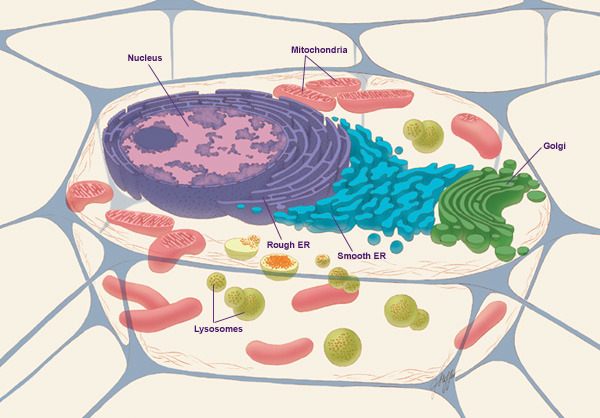
Animal cell NIH.jpg
Animal cell NIH.jpg
You need a microscope to see them because they are so small. Some cells help you grow, and others give you energy.
Plant cell structure-en.svg
Cells are the building blocks of all life.

55 words

Every living thing, from a tiny bug to a giant tree, is made of cells. The word "cell" comes from a Latin word that means "small room."

RobertHookeMicrographia1665.jpg
Most cells are so tiny you can only see them with a microscope. Inside, they have a jelly called cytoplasm and a thin skin called a membrane.
Cell membrane drawing-en.svg
A "wow" fact is that cells first appeared on Earth about four billion years ago! There are two main types: prokaryotes, which are simple like bacteria, and eukaryotes, which make up plants and animals.
Plant cell structure-en.svg
Cells work like little factories to keep you healthy and help you grow.

108 words

Cells are the basic building blocks of all living organisms. They were discovered in 1665 by Robert Hooke, who thought they looked like the small rooms in a monastery.

RobertHookeMicrographia1665.jpg
All cells have a protective outer layer called a cell membrane and a jelly-like center called cytoplasm. Inside, they contain genetic material (DNA) that acts like an instruction manual for life.
DNA structure infographic-5.svg

Scientists group life into two types: prokaryotes and eukaryotes. Prokaryotes, like bacteria, are very simple and do not have a nucleus (a center to hold DNA). While most are tiny, one amazing bacterium called Thiomargarita magnifica is 1 cm long and can be seen with the naked eye! Eukaryotes, which include plants and animals, are more complex.

Celltypes.svg
Celltypes.svg
They have a nucleus and special parts called organelles that do specific jobs. For example, mitochondria provide energy, while chloroplasts in plants help make food from sunlight.
Plant cell structure-en.svg
Most cells can replicate, which means they make copies of themselves so an organism can grow or heal.

170 words

The cell is the fundamental structural and functional unit of all life. The term "cell" was coined by Robert Hooke in 1665 when he observed a thin slice of cork under a microscope and saw structures that reminded him of a monastery's small rooms.

RobertHookeMicrographia1665.jpg
In 1839, Matthias Schleiden and Theodor Schwann developed "Cell Theory," which states that all organisms are composed of one or more cells, and that all cells come from pre-existing cells.

Organisms are divided into two main groups: prokaryotes and eukaryotes. Prokaryotes, such as bacteria and archaea, are single-celled and lack a membrane-bound nucleus. Instead, their DNA is located in a region called a nucleoid.

Average prokaryote cell- en.svg
Eukaryotes include animals, plants, and fungi. Their cells are much larger and contain a nucleus protected by a nuclear membrane.
Celltypes.svg
Celltypes.svg
Eukaryotic cells also contain specialized structures called organelles, which function like the organs in your body.

Animal cells are enclosed by a semipermeable cell membrane that protects the cell and controls what enters and leaves.

Structure of animal cell.JPG
Inside, the cytoplasm contains the cytoskeleton, a network of filaments that provides shape and support. Key organelles include mitochondria, which generate energy (ATP) through aerobic respiration, and ribosomes, which synthesize proteins. Plant cells have unique features, including a rigid cell wall made of cellulose and chloroplasts, which capture sunlight to create sugars through photosynthesis.
Plant cell structure-en.svg

Cells must perform several vital processes to survive and help an organism grow. During replication, a mother cell divides into two daughter cells. Bacteria do this through a simple process called binary fission, while eukaryotic cells use a more complex process called mitosis.

Binary fission.svg
Binary fission.svg
Cells also communicate through signaling, using receptors to detect chemicals like hormones. This coordination is essential for the development and health of multicellular organisms, which can be made of trillions of specialized somatic cells.

309 words

The cell is the basic structural, functional, and biological unit of all known organisms. Derived from the Latin word 'cellula' (small room), cells were first described by Robert Hooke in 1665 after he examined cork tissue.

RobertHookeMicrographia1665.jpg
The subsequent development of Cell Theory in 1839 by Schleiden and Schwann established that cells are the fundamental units of life. In 1855, Rudolf Virchow added the critical tenet that all cells arise from pre-existing cells. Today, we recognize two primary categories of life: prokaryotes and eukaryotes.

Prokaryotes, including the domains Bacteria and Archaea, are characterized by their lack of a membrane-bound nucleus. Their genetic material typically consists of a single circular chromosome located in the nucleoid.

Average prokaryote cell- en.svg
While most prokaryotes are microscopic (0.5 to 2.0 μm), some species like Thiomargarita magnifica can reach lengths of 1 cm. Archaea are particularly notable for their extremophile species, which thrive in high heat or salt, and their unique cell membranes composed of ether-linked lipids. Unlike bacteria, there are no known archaean pathogens.

Eukaryotic cells, which make up animals, plants, and fungi, are significantly more complex and can be 2 to 100 times larger than prokaryotes. Their defining feature is the membrane-bound nucleus, which houses the cell's linear chromosomes.

Diagram human cell nucleus multilang.svg
Eukaryotes possess an endomembrane system and various organelles. Mitochondria, the 'powerhouses' of the cell, generate ATP through oxidative phosphorylation. Interestingly, mitochondria possess their own DNA and multiply by binary fission, supporting the theory of symbiogenesis—the idea that they descended from ancient bacteria that entered into a symbiotic relationship with early cells.
Symbiogenesis 2 mergers.svg

The cell membrane, or plasma membrane, is a selectively permeable lipid bilayer described by the fluid mosaic model.

Cell membrane detailed diagram en.svg
It protects the cell and facilitates communication via surface receptors. Within the membrane lies the cytoplasm, containing the cytosol and the cytoskeleton. The cytoskeleton, composed of microtubules and filaments, maintains cell shape and assists in motility. Specialized organelles like the Golgi apparatus process proteins, while lysosomes contain enzymes to digest waste. Some cells even contain 'vaults,' large protein particles whose exact function remains speculative but may involve nuclear transport.

Cellular life is defined by complex processes including metabolism, signaling, and replication. DNA replication occurs during the S phase of the cell cycle, ensuring that daughter cells receive a full genome during mitosis.

DNA replication split.svg
Cells also have programmed death pathways, such as apoptosis and autophagy, to replace old or damaged cells. In multicellular organisms, cells differentiate from a single totipotent zygote into hundreds of specialized types, such as the 30 trillion cells found in the human body.

The history of life on Earth began with the emergence of cells approximately 4 billion years ago.

Stromatolites.jpg
Stromatolites.jpg
Eukaryogenesis occurred around 2.2 billion years ago, likely through the merger of an archaean and a bacterium. Multicellularity followed, with the first evidence appearing in cyanobacteria-like organisms 3 to 3.5 billion years ago. Modern research, aided by tools like the electron microscope invented by Ernst Ruska in 1931, continues to reveal the intricate molecular mechanisms that allow these 'small rooms' to sustain all life on Earth.
HeLa cells stained with Hoechst 33258.jpg

526 words

🖼️ Images & Media (24)

File:Symbiogenesis 2 mergers.svg
Symbiogenesis 2 mergers.svg
File:Cell membrane detailed diagram en.svg
Cell membrane detailed diagram en.svg
File:DNA structure infographic-5.svg
DNA structure infographic-5.svg
File:Cell membrane drawing-en.svg
Cell membrane drawing-en.svg
File:Three cell growth types.svg
Three cell growth types.svg
File:Average prokaryote cell- en.svg
Average prokaryote cell- en.svg
File:Plant cell structure-en.svg
Plant cell structure-en.svg
File:Celltypes.svg
Celltypes.svg
File:Diagram human cell nucleus multilang.svg
Diagram human cell nucleus multilang.svg
File:Semi-protection-shackle.svg
Semi-protection-shackle.svg
File:DNA replication split.svg
DNA replication split.svg
File:Binary fission.svg
Binary fission.svg

+ 12 more

🔗 What's this?

Concepts mentioned in this article

🔬 Go deeper

More advanced topics to explore

🪜 Step back

Simpler topics to build understanding